Here is a impromptu discussion on Biblical Christianity in contrast to Mormonism.
https://www.facebook.com/reasonablefaithyc/videos/226792158549357/?vh=e&d=n
Showing posts with label Biblical Theology. Show all posts
Showing posts with label Biblical Theology. Show all posts
Saturday, April 11, 2020

Sunday, July 12, 2015
Sovereignty and Scripturalism
What I've been thinking about lately:
I read a post of an Arminian that argued sovereignty is a contingent attribute of God. I couldn't help but think this in and of itself doesn't go far; one must distinguish between eternal or temporal contingency. Still, this doesn't help the Arminian's case since sovereignty seems to be essentially grounded in all of God's attributes (i.e. authority, knowledge, power, goodness, freedom and control). Perhaps, one could say God is sovereign independent of creation in virtue of God qua God exists in all possible worlds with the power to actualize any possible world He eternally decrees by divine wisdom. In a sense God is sovereign over those things which are possible (things He chooses not to actualize) and those things which are actual (things He has created).
Steve Hays posted a critique of Scripturalism; I've enjoyed his interaction with Ryan a Clarkian in the comments section. Paul Manata made a comment that I think is worth considering. Can epistemic infallablism be shown to be true? If it is possible then must it be actual? Cannot axiom S5 help to demonstrate this? If so, is this wildly counterintuitive?
I read a post of an Arminian that argued sovereignty is a contingent attribute of God. I couldn't help but think this in and of itself doesn't go far; one must distinguish between eternal or temporal contingency. Still, this doesn't help the Arminian's case since sovereignty seems to be essentially grounded in all of God's attributes (i.e. authority, knowledge, power, goodness, freedom and control). Perhaps, one could say God is sovereign independent of creation in virtue of God qua God exists in all possible worlds with the power to actualize any possible world He eternally decrees by divine wisdom. In a sense God is sovereign over those things which are possible (things He chooses not to actualize) and those things which are actual (things He has created).
Steve Hays posted a critique of Scripturalism; I've enjoyed his interaction with Ryan a Clarkian in the comments section. Paul Manata made a comment that I think is worth considering. Can epistemic infallablism be shown to be true? If it is possible then must it be actual? Cannot axiom S5 help to demonstrate this? If so, is this wildly counterintuitive?
Monday, October 27, 2014
Saturday, June 28, 2014
Church Fideism?

I listened to a sermon, "Partners in God's Amazing Plan," by local Pastor Dave Bryan of Glad Tidings Church. It struck me that the sermon was highly antagonistic to an intellectually satisfying faith. Pastor Bryan rightly expressed the desire to fulfill the command, in 1 Peter 3:15-16; 2 Corinthians 5:11, to give an answer for our hope--to persuade men. But then leaves us with no hope of fulfilling this command. Pastor Bryan spends much time interpreting God's plan, as corporate election, justification, adoption, sanctification and glorification, in terms of Pastor Bryan's presuppositions. The sermon, simply, does not deal with scripture exegetically to be challenged and shaped by the Bible. Scripture (e.g. Romans 8 and 9) is to be read with proper hermeneutical principles to exegete, the text, to know God's revelation. Understanding God's revelation in Scripture cannot be treated as a trifling matter; it requires much study, prayer, and the Holy Spirit's illumination. Don't miss my point. I'm not saying one must be a Pastor or PhD candidate to understand God's Word, I am simply saying to understand the deep things of God requires more than a surface reading of the text.
The sermon seems to disparage logic. Or, at least, makes the Christian faith a choice between rationalism or fideism. But this is a false dilemma. There is another choice between the two options; there is divine revelation-- that integrates both together. We can have, a reasonable, intellectually satisfying, secure, faith based on God's revelation.
The sermon claims God's plan for mankind is to partake in God's glory. This is an ambiguous statement. It needs to be spelled out precisely, how Christians will take part in God's glory. Pastor Bryan goes so far as to assert Christians are to be both God and man as Christ is the God-Man. Such a teaching comes terribly close to the Word of Faith movement's little gods doctrine, perhaps a complete affirmation of it. It sounds like a call to retreat to the Eastern Orthodox's mystic tradition of theosis. At the end of the sermon there are hints at the logical impossibility of man being a god. Furthermore, the apostle Paul sharply argues against the "man to gods" doctrine in Romans with the creator/creature distinction. Likewise, in Acts 17, Paul tells us we are creatures under the control of God, the most perfect being. By Paul's very explanation, only God has the essential properties to be God. And these essential properties cannot be communicated to a mere man. There is no possible world, which a mere man can be a god. Since it is logically impossible for a mere man to be given properties only God can possess. In other words, if God would share his nature with other creatures, he would have to cease to be God. Let me explain. Think for a moment, can there exist more than one perfect being--God? The moment you say--yes, you are left in meaninglessness. For it is logically impossible for two perfect beings to exist, since one cancels the other out. If there were two beings in the world both could not have the essential properties of a perfect being, like all-power, self-sufficiency, independence, all-control, thus both could not be God. Yet we are told to believe God is going to make all Christians perfect beings? What text says this? Last time I checked, glorification does not equal deification.
Friday, May 9, 2014
Dr. Anderson v. Dr. Craig
I recently listened to Dr. William Lane Craig's Reasonable Faith Podcast, in which, he criticized Dr. James Anderson's recent post on middle knowledge. I wanted to direct my readers to Dr. Anderson's reply to Dr. Craig here. Make sure to read Dr. Anderson's interaction with Dr. Greg Welty in the comments.
After thinking through Dr. Craig's criticisms and Dr. Anderson's counter arguments, I wonder what would Dr. Craig say to fictional middle knowledge? Why not consider middle knowledge the same as Dr. Craig's fictionalism? Wouldn't such a view withstand Dr. Travis Campbell's criticisms? It plausibly would give Calvinists a way of speaking about God's providence, much like possible world semantics, without the metaphysical baggage of excluding counterfactals from God's natural knowledge. Just some thoughts!
After thinking through Dr. Craig's criticisms and Dr. Anderson's counter arguments, I wonder what would Dr. Craig say to fictional middle knowledge? Why not consider middle knowledge the same as Dr. Craig's fictionalism? Wouldn't such a view withstand Dr. Travis Campbell's criticisms? It plausibly would give Calvinists a way of speaking about God's providence, much like possible world semantics, without the metaphysical baggage of excluding counterfactals from God's natural knowledge. Just some thoughts!
Thursday, March 13, 2014
Evangelism Explosion
I said in a previous post Evangelism Explosion could easily be revised for those that desire it. Personally, I think it is fine just the way James D. Kennedy first penned it. My Calvinism is not diminished by EE. But for those that feel it does here are some revisions that can ease those that feel tension with their consciences.
God
God is merciful and therefore does not want to punish people
Christ
What He did: He died on the cross and rose from the grave to pay the penalty for people's sins and purchase a place in heaven for them.
Commitment
Would you like to receive the gift of eternal life?
Let me clarify what this involves:
1.Transfer Trust:
2. Embrace Christ as Savor:
3. Embrace Christ as Lord:
4. Repent:
If you would like to receive eternal life let us go to God in prayer. Trust that in Him is salvation for you. He will not cast you out if you go to him for salvation.
God
God is merciful and therefore does not want to punish people
Christ
What He did: He died on the cross and rose from the grave to pay the penalty for people's sins and purchase a place in heaven for them.
Commitment
Would you like to receive the gift of eternal life?
Let me clarify what this involves:
1.Transfer Trust:
2. Embrace Christ as Savor:
3. Embrace Christ as Lord:
4. Repent:
If you would like to receive eternal life let us go to God in prayer. Trust that in Him is salvation for you. He will not cast you out if you go to him for salvation.
Tuesday, April 30, 2013
Logical Contradictions?
Divine Determinism and Human Freedom
Is God’s providence and man’s freedom incoherent? Most Christians would say no! Why, because there is a few different logically plausible models to account for Biblical teaching on the subject. Both models would affirm determinism and freedom are not incoherent ideas; however the models would disagree on the compatibility of determinism and freedom. One model, call it Arminian, argues determinism and freedom are incompatible. So the Arminian model affirms God guides human actions to accomplish His plans without violating human freedom. God knows everything including what humans will do in any situation. So God puts people in situations were He knows they will freely choose to do what is His plan. However, the Armianiam model stresses the fact that God must work with what He gets. There are many different ways God could have arranged the world but there was no logical possibility to save the most free creatures possible without the possibility of some freely choosing to sin. So there was risk on the part of God from the Arminian model.
The second model, call it the Calvinist model, argues determinism and freedom are compatible. The compatibility lies in the nature of freedom. The Calvinist model defines freedom as a creature’s ability to choose to will an act, without constraint, by his/hers desires, with a will he/she desires. Such a view of freedom is perfectly consistent with determinism so long as one can know any creature’s desires. Imagine there were two people Bill and Shawn. Suppose that Bill put a device in Shawn’s brain that enabled Bill to control Shawn’s actions with a remote. Lets say that Bill has determined Shawn will kill the President Barack Obama by pressing a button on the remote. But suppose further that Shawn already wants to kill the President without Bill having to use the remote, and Shawn kills the President. We would say Shawn didn’t have the ability to do otherwise than kill the President and yet we would say Shawn was morally responsible for his actions. This is due to the fact that Shawn did what he desired to do with the will he wanted. Now the question arises, how can one know in advance a free creature’s desires? Well, different factors can influence one’s desires, like genetics, parents, cultures, and friends; but the one thing the person has control over is his identity with those desires. For example, a person wanting to loose weight can either identify himself with food or identify himself with loosing weight. By difficult training one can train to have a stronger desire to loose weight than eat fat producing foods. God being omniscient knows what factors would influence an agent to cause him/her to choose one thing over another. Notice, I said "cause" an agent. Thus there are necessary and sufficient conditions for any agent's actions. To summarize then, God determines all things that come to pass in such a way that man freely determines what he most wants to do.
The Incarnation
JP Moreland and William Lane Craig give an interesting model of how Christians can defend the coherence of the incarnation. They argue if God intrinsically possesses all attributes that are required to be a human person then all that is needed for a genuine incarnation is a body. If the Divine Logos takes upon flesh that is sufficient for a legitimate incarnation. This view would sail smoothly away from Nestorianism. Since it does not make a "human soul" a necessary condition for being human. Or even if it does, the condition is all ready met in God's nature.
On such a model the mind of Christ being the divine Logos makes it difficult to explain the human character and experiences of Christ. The problem is solved, according to Moreland and Craig, by distinguishing Christ's consciousness and subconsciousness. If the divine thoughts are in the subconsciousness of Christ, then it can makes sense to say Jesus went through human experiences; he learned, cried, and suffered.
The Trinity
The Trinity is not contradictory since we are saying God is one in one sense and three in another sense. God is one in essence and three in personhood. God is one what and three who’s. In a more precise way, God is one incorporeal Spirit with three sets of cognitive faculties comprised of intellect, will and emotions. Another way to put it is God has three centers of self-consciousness.
Are there any other evidences that testify to God being Triune apart from Scripture? Well one way to see the plausibility of the Trinity is to think of the attribute love. What is love? It is an action, right? It is the act of giving one’s self to another. It is “otherness” instead of self-centeredness. A thought experiment would help here. Imagine if God did not choose to create the world. Would we still say God is all-loving before creation? How so? God had no one to love prior to creation. God was always loving. Since as Scripture says God is love (1 John 4:8). This requires God to love another prior to creation. To say one can love without someone to love is meaningless. The very concept of love requires another person to love. And it is unbiblical to think God created love. Thus we are left with the plausible conclusion that God as one being exists in three persons: the Father Son and Holy Spirit; and that they love each before the creation of anything.
Omnipotence
God can only do what is consistent with His character and nature. So can God do anything? Obviously not! He cannot stop willing His own existence. Nor can God stop being omnipotent and still be God. God cannot lie, or sin. Does this make God no longer omnipotent? No! The contradiction lies with the objector not defining omnipotence from faithful Biblical teaching.
Monday, March 11, 2013
Calvinism and Molinism
Greg Koukl gives a great explanation on why Christians ought not to take up middle knowledge as articulated by William Lane Craig.
Tuesday, March 5, 2013
When a Baby Dies

A
lot of evangelists these days have been witnessing at abortion clinics. I think
this is much needed, especially in our culture where it is saturated in
autonomy and man-centeredness. The true nature of abortion needs to be
confronted with God’s truth! But I think another issue related to abortion that
is both controversial and sensitive to all hearts needs to be addressed as abortion. What is the issue? It is the status of babies
when they die. Do "little persons" when they die go to heaven or
hell? Great men have respectfully disagreed on this issue.
In my judgment there are only three options, and two of them, I hope to show, reduce down to one position. The first position is all babies go to hell. It is alarming to our intuitions to think such a thing but often times God’s truth shatters what we think is morally right. This position is straightforwardly argued on the basis of original sin. If babies have both Adam’s imputed guilt, and disposition, then they are justly culpable.
The second position is all elect babies go to heaven. This position is argued on the basis that God will hold all mankind accountable for Adam’s guilt, disposition, and personal sins. But God has chosen a particular people (including “some” infants) to himself to save by propitiation through the life, death, burial and resurrection of Jesus Christ. They are saved and justified by grace through Christ’s atonement. On this view then God saves people two different ways. He either gives people faith to believe in Christ. Or He considers the elect people incapable to believe, i.e. infants or mentally disabled, as those in whom Christ’s righteousness and atonement is imputed. Thus one group of elect capable of exercising faith in God’s providence is justified by grace through faith in Christ. However, given God’s providence, there is another group of elect incapable of exercising faith in Christ, but Christ died on their behalf, so God declares them justified through Christ’s imputed righteousness and atonement.The last and final view is like the first. It states all elect babies will go to heaven, but adds, and all babies that die are elect. This position is identical to the previous position the difference lies in the acknowledgement of the quantity of babies that die are of the elect. The previous view argues some of the babies that die are of the elect whereas the latter view argues all the babies that die are of the elect. The arguments for the former and latter position, oddly enough, apply to both positions. So based on the arguments both the former and latter position collapses into one position. And therefore it becomes utterly arbitrary for a person to argue either some babies that die are elect or all babies that die are elect. Why? The arguments used by both views can forcefully establish either view. Now some unsatisfied with this predicament have taken up a pragmatic argument against the last position. They say that if such a position is true it morally justifies abortion. Since abortion would guarantee a baby into heaven. What is the problem with this argument? First, it is irrelevant to the moral status of abortion. Abortion is murder. And God has revealed murder is morally wrong. So nothing can justify a clear violation of God’s revealed law. But if you disagree, then you must ask your self, does the end always justify the means? If you say yes, then you undoubtedly hold to the most unbiblical, abhorring, monstrous utilitarianism that would even make Peter Singer cringe. A different approach to defend the latter position has also developed. Let's use Albert Mohler and Daniel Akin’s arguments as an example. Mohler and Akin write,
So far so good! What is said is biblically orthodox.
“First, the Bible revealsthat we are “brought forth in iniquity,”(1) and thus bear the stain of originalsin from the moment of our conception. Thus, we face squarely the sin problem.Second, we acknowledge that God is absolutely sovereign in salvation. We do not deserve salvation, and can do nothing to earn our salvation, and thus it is allof grace. Further we understand that our salvation is established by God’s election of sinners to salvation throughChrist. Third, we affirm that Scripture teaches that Jesus Christ is the soleand sufficient Savior, and that salvation comes only on the basis of His bloodatonement. Fourth, we affirm that the Bible teaches a dual eternal destiny –the redeemed to Heaven, the unredeemed to Hell.
The argument Mohler and Akin makes, as is articulated, denies infants are accountable for Adam's guilt. They therefore deny original sin. Such a position as so articulated is biblically unacceptable. A few revisions may be made to their argument to be immune to such criticism. First, we must admit God can hold all mankind (including infants and mentally disabled) accountable for Adams guilt. In fact, evidence that He in "some sense" does is by the death of all mankind. Secondly, we hold that God states He will judge all mankind for what they have done in the body. Thirdly, we state God can justly hold infants and the mentally disable accountable for Adams guilt, but, God in His grace and mercy, has revealed He has chosen not to hold infants and mentally handicapped for Adams guilt but instead has chosen to judge mankind by the deeds done in the body. Original sin as articulated is not denied on such a view. God can justly hold infants accountable for Adams guilt if He so chooses. But given God's providence and progressive revelation, it is admitted, He has revealed He will not hold them accountable for Adams guilt but graciously will judge them by the deeds done in the body. Some may still object and say such a view denies original sin in substance. For example, if John inherits a house. Lets say a relative left the house in debt to John. The debt can justly be transferred to John that inherited the house. So it is acknowledged thus far John can and is justly accountable for the debt transferred from relative to inheriting family member. But what if the debt collector or bank officer makes it where debt, though it is transferable, will no longer bind all members of any family responsible for debt attained by one member of any family? Each member would only be required to give an account for his or her own debt. But doesn’t this deny that the debt collector or bank officer will in fact hold the person responsible for the transferred debt? Yes. So how then can it be said it doesn't deny transferred debt accountability? Since it is admitted that such a debt exists and can be justly prosecuted. The main concern is resolved in the authorities provision to not collect the debt (from those who inherent it) but rather holding the respective person or persons who procured the debt as responsible for paying the debt. So it is all of grace, and grace alone."What, then is our basis for claiming that all those who diein infancy are among the elect? First, the Bible teaches that we are to bejudged on the basis of our deeds committed “in the body.”(2) That is, we willface the judgment seat of Christ and be judged, not on the basis of original sin, but for our sins committed during our own lifetimes. Each will answer“according to what he has done,”(3) and not for the sin of Adam. The imputationof Adam’s sin and guilt explains ourinability to respond to God without regeneration, but the Bible does not teachthat we will answer for Adam’s sin. Wewill answer for our own. But what about infants? Have those who die in infancycommitted such sins in the body? We believe not."
Mohler and Akin continues,
"Jesus instructed hisdisciples that they should “Permit the children to come to Me; do not hinderthem; for the Kingdom of God belongs to such as these.”(8) We believe that our Lord graciously and freely received all those who die in infancy – not on thebasis of their innocence or worthiness – but by his grace, made theirs throughthe atonement He purchased on the cross.
When we look into thegrave of one of these little ones, we do not place our hope and trust in thefalse promises of an unbiblical theology, in the instability of sentimentalism,in the cold analysis of human logic, nor in the cowardly refuge of ambiguity.We place our faith in Christ, and trust Him to be faithful to his Word. We claim the promises of the Scriptures and the assurance of the grace of our Lord. We know that heaven will be filled with those who never grewto maturity on earth, but in heaven will greet us completed in Christ. Let usresolve by grace to meet them there.”
I say Amen!
(1) Psalm 51:5
(2) 2 Corinthians 5:10
(3) Ibid
Albert Mohler and Daniel Akin. The Salvation of the 'Little Ones': Do Infants who Die go to Heaven? 2009. Here

Wednesday, February 13, 2013
Harmatology

Quick thoughts
Evil
No simple answer. Some (e.g. Oliver Crisp, Plantinga, Van Inwagen) would appeal to the possibility of libertarian freedom. Any agent can act contrary to her disposition and nature. This appeal fails to explain precisely how sin came to exist since libertarian freedom reduces to capriciousness. Others see sin as a privation of good. Still, others would argue Satan, a created peccable Angel, chose a lesser good, namely self-love, above the greatest Good, God himself. Notice, this is consistent with divine determinism and (compatibilistic)freedom.
Why would God allow this to obtain? God has a morally sufficient reason, it is for His glory and our good. I'll leave it there for now.
Sin
Sin was transmitted either by realism or federal headship. I take both to be true. If realism and traducianism are true then sin can be inherited. Adam sinned thus God justly remove his goodness and restraining Grace. The result was catastrophic the very heart of man was corrupt and darkened. Perhaps you reject realism and traducianism, then one can resort to federal headship with creationism. God gave a command to Adam. Adam disobeyed. Therefore, as punishment God creates each soul with a sinful inclination.
Federal headship accounts for guilt imputed. We possess Adam's guilt since he represented us before God. Once he sinned we were liable for his sin as our representative. We sin by imitation as we encounter sinful role models that influence us to sin.
Thus we are sinners by inheritance, imputation and imitation.
In Detail
The only difficulty, I see, is making sense of the origin of sin without appealing to any libertarian conception of freedom. And this directly leads to the question, who is morally responsible or blameworthy for sin? The moral character of God would strongly deny even the logical possibility of God as the author of sin. This is consistent with the Scriptures conception of God as the most perfect being. Some have affirmed hard determinism to unabashedly ague God is the author of evil yet without sin.
(1) God is the only agent that causes all things. [This is an important premise to distinguish hard and soft determinism]
(2) Man sins.
(3) God causes man's sins.
(4) God is responsible for man's sins.
But even if one grants hard determinism, this is not a problem, since all one has to do is adopt volunteerism. God could not be held responsible for sin, on such a view, given the fact God is ex lex. God would be above the laws and commands He gives to His creation. Furthermore, on such a view the requirement for responsibility would be satisfied. God the highest moral authority would hold man responsible for sin since He is the ultimate authority. I agree, though, such a view is not appealing. Perhaps a moderate view of divine command theory can be properly utilized to argue the same conclusion without the intractable problems of volunteerism.
So how could Satan sin? What is sin? How do people become sinners? The scriptures tell us that only Adam and Eve as the first humans became sinners every person subsequent to Adam is (i.e. exists qua) a sinner. Humans ‘are’ sinners while Adam and Eve ‘became’ sinners.
Sin: Definitions
- Sin is any state, disposition, or act that violates God’s commandments.
- Sin is anything that is contrary to the purposes, character, and nature of God.
- Analysis: Let sin (as a verb such as "sinned" or adjective "sinful") stand for S, and A stand for agent.
(1) If, and only if, an agent is sinful, or wills sin or does sin, then a subject is sinful. This doesn’t seem broad enough to include circumstances thus a revision must be made.
(1)’ If, and only if, an agent is sinful, or wills sin or does sin in circumstances that are sinful, then a subject is sinful.
II. Origin of Sin
- Satan:
It is speculative what sin Satan committed. Many people have refereed to pride, selfishness, or self-love as Satan’s sin. He wanted to take God’s place. Satan was good, but he was able to sin. God determined Satan to sin and Satan determined to sin. Satan must have reasoned he should have all that God possesses. Perhaps, external things influenced him; and he gained a stronger desire to sin than to obey God. Notice, however, no matter which sin Satan committed, he always had a reason that motivated him. At no point did Satan sin without a reason (though a bad one at that) or purpose. But how could good choose evil? How could a good creature choose to sin than continue to do good? This is logically possible when we understand Satan was not perfect, impeccable, or omni-benevolent. Therefore, he possessed the ability to do evil. Satan sinned in a way that was quite consistent with his nature.
III. Transmission of Sin
My analysis suggests sin cannot be thought of as a mere bad habit, or evil tendency learned and then internalized. It is not something nurtured in a child. Sinful desires can be cultivated or de-cultivated, but they do not derive from cultivation. Sin is a property all mere humans (thus excluding Christ who was not a mere human), possess. All members of a class possess the property of sin, iff the federal head of that class possesses. Adam sinned, therefore, all mere humans sinned in Adam. But what is the property of sin? Is it transmittable? Sin is not a physical property like H2O, nor is it a supervening property like wetness. It is a property that deals with the soul; therefore, it must be immaterial. Or could it be the lack of a property that gives rise to man's continual sinfulness? Edwards and Augustine thought so! Could it be that God created Adam with certain properties that enabled him to choose between good and evil, and after his choice of evil God was obligated to remove these properties in man? It is not clear if sin is a property or a privation. Whichever position is assumed will lead to different conclusions on the transmission of sin. Either, God, as punishment for Adams sin put in man a positive property for sin (i.e. disposition) or God removed a property from man as punishment for Adam’s sin. It seems more plausible that God removed than added a property that resulted in man being sinners. Such a conclusion would be consistent with God’s character. But what could the property be? Was Adam’s disposition towards good prior to the fall? If so, how could he choose to sin? If God created man to be in constant union with God, and to partake of his goodness this could be disrupted by Adam’s sin. God would have no choice but to punish Adam for sin by leaving man to himself. To leave man with a darkened heart. Man was to live with the light of God but once Adam sinned God was obligated to punish him. This could have resulted in man being left in darkness. God by removing the property of his grace and communion with man leaves man to himself. Man became self-centered and not God-centered. He loved himself more than God. Adam was created good, and therefore, must possess an inclination for good. This inclination was over come by Eve who was convinced by the serpent. The chain of causes and effects lead directly back to Satan. Satan, Adam and Eve were constantly influenced to do good but they determined in their own minds to do that which is evil. Their strong desires to do evil were planned by God. But only those beings which sin can be held responsible for sin since they willingly, deliberately, knowingly and purposely sinned. Some may object and say that since God knew their motives he should have stopped them from sinning But where does this ‘should’ come from? Obviously it is from God, right? If so, we must assume God planned sin and evil with a morally sufficient reason. Both the Calvinist and Arminian must conclude God included sin and evil in His divine plan for a good reason.
However, the Arminian says that God wanted to preserve libertarian freedom, which necessitates the possibility for sin and evil to enter into any possible world. In fact, the arminian argues that there is no possible world with creatures that possess libertarian freedom, with the amount of people like the actual world, in which each creature freely chooses not to sin. The number of people with libertarian freedom increases in any state of affairs the potential of sin and evil being committed by those free creatures. Out of all the possible worlds God could have created the options were limited according to the Arminians by God's desire of what was feasible. The Arminian says God could not make a possible world obtain where God determined all of His creatures would freely love and worship Him. Since such a state of affairs would be logically impossible. Something cannot be both determined and free according to the Arminian. God chose the possible world in which He could achieve His plan. The dispute between Calvinists and Arminians is on the nature of God’s plan. Both agree God does not coerce his creatures to act. Hence, they agree God’s moral creatures voluntary act. Thus sin can only rightly be traced back to free creatures. However, the objection still stands, that if God knew X was going to obtain, and he could prevent it, is He not responsible for X obtaining? As Paul says, “Who are you oh man to answer back unto God?” We cannot object to God’s actions since we do not have a moral or logical standard apart from Him. God is all wise, all good, and all knowing, so on faith, we must trust He knows best. So is this the best possible world? Only God is in a position to say what is ‘best’ not us. Only God is intrinsically God. Adam was derivatively good. Adam was created in God’s image. But moral perfection is exclusively an essential property of God not man. Hence man is not in a moral position to question God. However, we can determine that if God can stop Adam from sinning but did not, even though knowing Adam was going to sin; we must conclude it was for a morally sufficient reason. If what I have stated thus far is true, it follows its both metaphysically, logically and morally impossible for God to sin given His moral character and nature. For sin would violate God’s nature which He has revealed. Therefore, we can say in some sense the cause of sin is God, but the author of sin is free-creatures. Only creatures can be properly blamed for sin not the Creator of those creatures. But how does sin get transmitted? Before I can answer this question, I must go back to the subject of sin. The more I think about sin in my own life I am convinced it must be more than a lack or privation. An inability to do what I ought doesn’t seem to require a new nature as 2 Corinthians 5:17 states. It seems the positive disposition toward sin could not merely be a privation. Perhaps God when He instructed Adam and commanded him not to eat of the forbidden fruit the violation of the command had the consequence of dying spiritually that entailed guilt, and a disposition to sin to all mankind. This disposition became natural when it was unnatural. Adam was created with a disposition of righteousness, but then this disposition changed to unrighteousness as punishment for sin. The sinful bias in man from Adam to his decedents was passed on by a legal declaration, inheritance and imitation. God transmits the sinful bias in man either directly or indirectly. Sin deals with the soul. But the human soul is either individually created by God or by humans with God’s directive. Either God gave man the ability to reproduce after their own kind which includes both body and soul. Or man produces bodies by procreation and God creates souls for them. It seems to me we should understand sin as being transmitted by procreation. The sinful bias is transferred by inheritance. Person X reproduces with person Y and conceives a child XY with dispositions from both parents. What is included in all cases with mere humans is they are all born sinners. As a human soul inhabits a body and all its various physical parts this likely includes any given woman's egg, and man's sperm.
Summary
Sin is a state, disposition or action that violates God’s commandments, which reflect His essential good nature. Sin originated with His creatures and not the Creator. Satan and Adam sinned willfully according to their natures. They were never forced to sin but chose by their own reasoning. Subsequent to Adam’s sin, man died spiritually. This entails man is born sinful in a fallen world. Man inherited from Adam a sinful nature, i.e. a soul that ultimately desires sin and uses the body to reach that end. Sin is transmitted by imputation, inheritance, and imitation. Sin is inherited through procreation. A man and woman reproduce after their own kind; hence they reproduce bodies and souls by procreation. A man with a woman produces a human being with a sinful nature. At regeneration a person is given a new nature and therefore, his sinful nature is removed. Thus his new nature, with its desires, is to please God. He still sins but not fully willing. He does not fully consent to sin nor does he find his identity from it.
Previous posts that are directly related, When a Baby Dies, God, Why is there Evil?, Anderson, Calvinism and the First Sin, Craig, Providence and Calvinism, and Original Sin and Middle Knowledge.
Resources
Michael, C Rea. The Metaphysics of Original Sin Here
Paul Copan. Original Sin and Christian Philosophy Here
Jonathan Edwards. Original Sin Defended Here
Paul Helm. Blog Entry Here
The Problem of Sin and Evil

The problem of sin and evil can be resolved by the fact God is the standard of good. His commandments and actions are a reflection of His omnibenevolent nature. The reason God planned the existence of evil and sin in His providence is not fully disclosed by God but He has revealed Who He is. Hence, He must have a morally sufficient reason for why He has planned sin and evil to existence given His nature. Furthermore, God uses sin and evil for ultimately good. Therefore, we ought to trust God and His providence.
A wonderful argument by Paul Helm regarding sin and evil.
See
Paul Helm. Eternal God. 2nd Ed. (Oxford: Oxford P, 2010)p.162.
Downing, William. The Problem of Evil Here
Tuesday, February 12, 2013
Evangelism, and Mormons
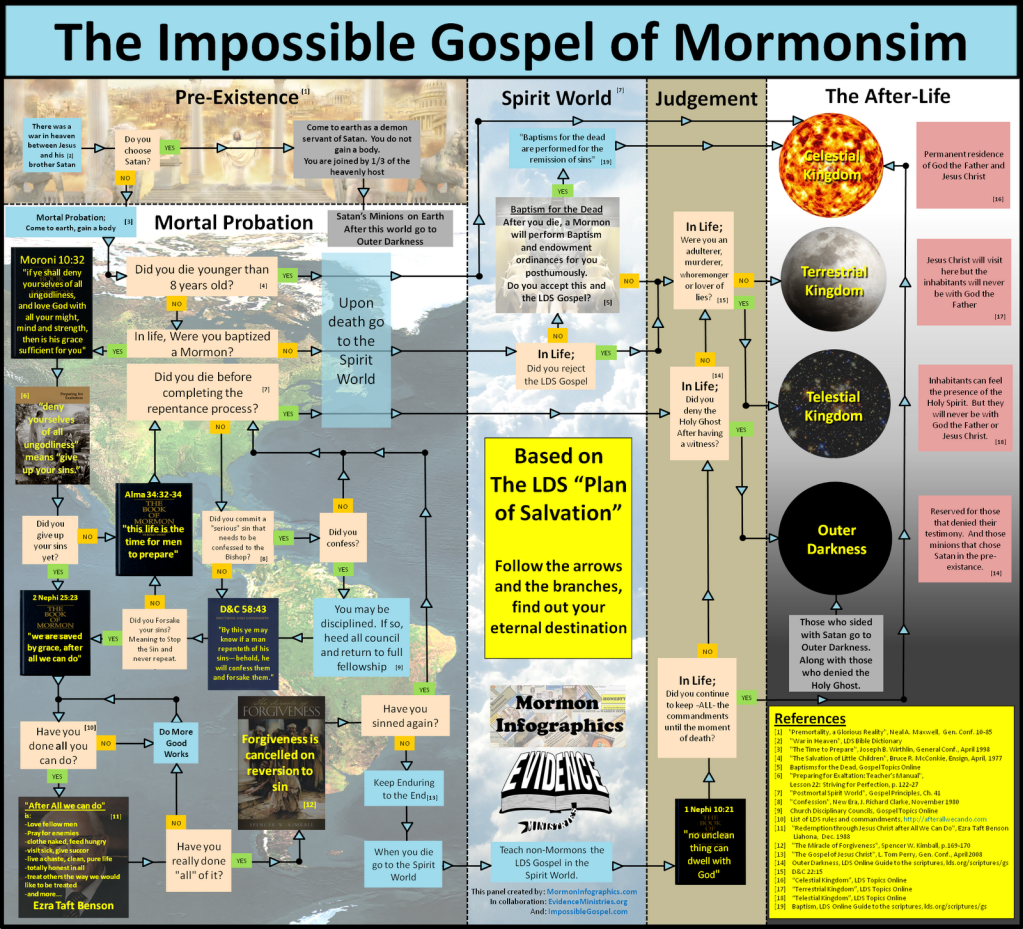
It is important when witnessing to Mormons to know what they believe. Here is a quick summary:
The most effective way to witness to Latter Day Saints (i.e. LDS, Mormons):
Part 1
Part 2
Monday, February 11, 2013
Divine Timelessness and Craig
William Lane Craig’s claim: God is timeless prior to creation, and
temporal subsequent to creation
(1) If God does not know all counterfactuals prior to
creation, then He is not omniscient.
(2) God cannot know tensed counterfactuals prior to
creation (Since God is timeless prior to creation according to Craig).
(3) Therefore, God is not omniscient.
(4) However, God is omniscient, and therefore knows all
counterfactuals prior to creation.
(5) So, God knows tensed counterfactuals prior to
creation. (This conclusion demonstrates God can be timeless and know tensed facts
given Craig’s own presuppositions).
Jehovah Witnesses, and the Trinity
I will focus my attention to the April 2012 edition of the Watchtower
magazine. I wish to show that Jesus is God. Now I am full aware that I cannot
answer every objection to the satisfaction of everyone; the reason is plain,
some people will rather die than put their most intimate convictions on trial
by God’s Word. I think we all are all guilty of this at one point.
There are two sections in the April edition of the
Watchtower that deal with the subject of Christ’s identity. On page 5 under the
title “Is Jesus really God,” the arguments against Christ’s deity in this
section can be summarized as follows: (1) Jesus was subordinate to God (2) Jesus
spoke as though he was “separate” from God. From these two arguments the
conclusion is drawn that Jesus cannot be God.
The passage Matthew 27:46 is cited where Jesus is on the
cross and yells in Aramaic, “My God, My God, Why hath thou forsaken me?” What
Christ said was clearly a direct quotation used from Psalm 22:1 as a witness to
all, he was the prophesied Messiah. But doesn’t this mean that Christ was
merely a man since he said “my God”? If he is God should not the very thing he
said be odd? Since Jesus said “my God” it seems he is subordinate to another,
namely God. For example, when an
employee speaks of his employer, he says “my boss.” This denotes subordination.
Jesus says, “The Father is greater than I (John 14:28).” It seems clear Christ
indicates he submits to the Father. What do we make of this argument? It seems
to me, there is unargued assumption that if one is subordinate to another this
entails an inferiority of nature. So this needs to be proven. Yet prima facie
this assumption is false. Reconsider the example of an employee and employer.
Is the employee inferior to the employer since he is subordinate? At best all
one can say is that the employer has a greater position than the employee but
this does not entail they are not equal in nature. That is to say both are
human with the same moral worth. The employer is no better than the employee.
This can be applied to Christ and the Father. Both are equal in nature but the
Father has a different role than the Son. Another example can be given when we
consider the marriage relationship. The Scriptures teach a woman is to be
subordinate to her husband. “Wives, submit to your husbands, as is fitting in
the Lord (Col 3:18 ESV).” Since a woman is to submit to her husband are we to
conclude she is inferior to her husband? If by inferior we mean in nature then
obviously not. Man and woman are equal before God. But the scriptures teach God
has given man a different role than woman to be the leader of the home. Notice
one can have a different role or position than another and yet be equal in
nature. Lets use this principle in practice. The Apostle Paul writes “But I
want you to understand that Christ is the head of every man, and the man is the
head of a woman, and God is the head of Christ (1 Corinthians 11:3 NASB).” What are we to exegete from this
passage? That man is inferior to Christ, Christ is inferior to God and that
woman is inferior to man? No! The context is Paul writing to the Corinthian
church to be orderly. Here he teaches them differences in function or roles.
But clearly difference in function or roles does not indicate inferiority of
nature.
The
next argument is that Jesus claims to be separate from the Father. Countless
passages can be cited where Jesus speaks about doing the Father’s will. Or him
telling Pharisees his teachings are from God. These passages are believed to
show Christ is separate from God. Precisely in what sense does one mean
separate? Ontologically? If Jesus is the Logos that took upon flesh and dwelt
among us as John 1:1 teaches, then he ought to speak of God as he does. If God
takes upon a human nature, he wouldn’t be an atheist. Christ being both fully
God and man he would have to refer to the Father as separate from his humanity.
That is to say if Christ as a single person has two natures, deity and
humanity, he would have to properly speak as he did. That is not to say however
that Christ was speaking about himself. It is wrongheaded to think that if
Christ is both God and man then theses verses imply his humanity is speaking of
his divinity. This assumes Unitarian monotheism and doesn’t consider
Trinitarian monotheism; plus it does not allow the text to speak for itself.
Christ constantly made a distinction between himself and the Father. And here I
take these verses are further illuminative in showing the distinction between
the Son and the Father as persons. But it does not however show Jesus and the
Father are ontologically separate.
Jesus said at one point that authority was given to him. It
is argued that if Jesus were God he would already have all authority. In John
1:1,14 and Philippians 2:6-9 it is taught that Christ being God took upon
flesh. Lets focus on Philippians 2:5-11 to establish this point. Many scholars
identify these verses in Philippians as an early hymn. It is called the Carmen
Christi. The context of these verses is Paul teaching the Philippians to have
humility of mind as Christ. Humility as such can be characterized by verse 4 as
possessing certain rights but giving those up to serve others. Now Christ is to
be our example of true humility and we are to imitate him. The passage says,
“…He [Christ] existed in the form of God….” The term “form” comes from the
Greek word morphe. It means the “outward display of the inner reality or
substance. Here it refers to the outward display of the divine substance, i.e.,
divinity of the preexistent Christ in the display of his glory as being in the
image of the Father.”[1]
Hence most translations render this “God by nature.” This means not merely the state of being God but divine
existence as the preexistent Christ. Paul goes on. He says He who (eternally)
existed in the form of God did not “regard equality of God a thing to be
grasped”(NASB). Some interpret this phrase, as Christ did not grasp after
equality with God implying it was not something he already possessed. But the
context must determine the meaning so it must not be assumed this is what he
meant. Paul makes some concluding remarks that are contrasted. Christ did not
grasp after equality with God but rather emptied himself. This passage
indicates it was a voluntary emptying done by Christ. Paul uses this term
“emptying” as a metaphor in other places as well (e.g. Romans 4:14). Paul
clearly makes a connection between emptying and taking. He “becomes flesh” by
taking the “form” of a bondservant and being made in the likeness of man. Its
no accident Paul uses the same word “form” to refer to Christ’s divinity and
becoming a bondservant, taking humanity. It is to show a true act of humility.
The very one that was served and worshiped by Angels and man takes upon the
lowly existence of man. Now let us ask given the context what is true humility?
Is it the idea of an inferior created being not usurping someone in a greater
position? Is it “humble” for an employee to not try and take the job of his
employer? Certainly not! However, what about the second understanding of this
passage. Christ the preexistent Logos by very nature God. He being equal with
the Father in deity with all its privileges, but he does not consider that
position something to hold on to at all costs. But out of love he rather takes
upon the lowly existence of a man to go to the for his peoples sins. He
voluntarily lays aside his privileges as God and takes the form of a man. He
becomes a servant. He serves those he came to redeem at the cross. Paul
distinguishes the Son from the Father often calling the Father “God” and Jesus
“Lord.” Isaiah 45:23 is quoted by Paul speaking of God and he applies it to
Jesus revealing further his deity.
So Jesus was both fully God and man as one person. Thus he
could rightfully say that authority was given to him, which he did not have, as
a man.
Questions for Witnesses:
1. Who raised Jesus from the dead?
Acts 4:10, John 2:19, Romans 8:11
2.Who is Jesus Father?
John 3:16
Matt 1:18
Who created the heavens and the earth?
Gen 1:1, John 1:3, 1:1,1:14, Col 1:14-17, Job 26:13, Gen
1:2, Isai 44:24 and Job 9:5-8
Who is the Lord God Almighty, the Alpha and Omega, the First
and Last?
Rev 1:8 who is the one ” which is, who was, and which is to
come?
Rev 1:17-18
Rev 4:8
Rev 11:17
Who did the Apostles believe Jesus to be?
John 1:49, John 20:28, John 1:1,14, 1 Tim 3:16,
What title does Heavenly Father give to Jesus?
Luke 9:35
Hebrews 1:8
Objections to Christ’s deity revisited:
Col 1:16-17
This verse does not teach Christ is created. The term “first
born” in Greek does not mean first created. Further, it must be interpreted in
its context. The latter part of the verse says “He [Jesus] is before all things
(the word “other” is added in the NWT but it is not in the Greek); according to
this verse then how can Jesus be a created thing if he is before all things?
Logically he cannot. Either he is before all things or he himself is a thing
created by God and therefore cannot be before all things. We ought to
understand the term “firstborn” to mean preeminent or heir, as Jews understood
the term in Hebraic tradition.
Rev 3:14
The term archa translated beginning can be rightly rendered
origin or source. Even the “Reasoning” book acknowledges this fact.
John 14:28
Again a different function or role does not entail an
inferiority of nature.
Proverbs 8 The wider context of Chapter 8 in the middle of
Chapter 7 and 9 speaks of wisdom in the feminine gender. Chapter 7 tells us to
call wisdom our sister. Clearly the wisdom spoken of in this chapter cannot
refer to Jesus. Even so, this is a personification of wisdom in the literary
genre of proverbs and should not be taken as precise doctrine.
The Trinity
First let us go to some passages in
Scripture to build the foundations for how we ought to understand God.
Det 6:4
Mark 12:28-33
1 Corinthians 8:4
Foundation 1: Monotheism, God is one,
It is an indisputable fact that the clear teaching of
scripture is monotheism. There is one God. Nevertheless, there are passages that seem to refer to other
gods, but when you look at the context of such scriptures it is evident they
are speaking of either: idols, angels or kings in a metaphorical way. Examples
of such passages would be Psalm 82, John 10, and 1 Corinthians 8.
Foundation 2: There are three named, the Father, Son, and
Holy Spirit called God.
The Father: Jesus’ model prayer
1 Peter
The Son: Mark
Exodus, Mark 6:51
John 20:28
Phil 3:5
The Holy Spirit: Acts 5, 1 Corin 6:19
Foundation 3: The three named, Father, Son, and Holy Spirit,
are persons.
John 15:26
Notice the Father sends the Spirit to testify of the Son.
The three are spoken of as persons. But note how the Holy Spirit is spoken of
with the personal pronoun “He.”
John 17:5
Foundation 4: The three persons, Father, Son, and Holy
Spirit are the one God. This foundation necessarily follows from the other two.
Here we draw the conclusion from scripture the Tri-unity of God, the 3 in
oneness, commonly called the doctrine of the Trinity.
The term “Trinity” is nowhere to be found in scripture. But
it refers to a biblical doctrine. Much like the term omnipresence is not found
in scripture, but the idea of God being everywhere present is clearly taught in
scripture. So although the term
“Trinity” is not in scripture the truth in which the word refers to is taught
in scripture. The word Trinity can be traced to Latin roots, ‘tri’ meaning
three and ‘unity’ meaning one. The word literally means three in one.
The four foundations build from scripture the teaching that
the one God is three persons, Father, Son, and Holy Spirit. But what exactly
are we saying? How is God one and
yet three? Isn’t the Trinity contradictory?
The Trinity is not contradictory since we are saying God is
one in one sense and three in another sense. God is one in essence and three in
personhood. God is one what and three who’s. In a more precise way, God is one
incorporeal Spirit with three sets of cognitive faculties comprised of
intellect, will and emotions. Another way to put it is God has three centers of
self-consciousness.
Are there any other evidences that testify to God being
Triune apart from Scripture? Well one way to see the plausibility of the
Trinity is to think of the attribute love. What is love? It is an action,
right? It is the act of giving one’s self to another. It is “otherness” instead
of self-centeredness. A thought experiment would help here. Imagine if God did
not choose to create the world. Would we still say God is all-loving before
creation? How so? God had no one to love prior to creation. God was always
loving. Since as Scripture says God is love (1 John 4:8). This requires God to
love another prior to creation. To say one can love without someone to love is
meaningless. The very concept of love requires another person to love. And it
is unbiblical to think God created love. Thus we are left with the plausible
conclusion that God as one being exists in three persons: the Father Son and
Holy Spirit; and that they love each before the creation of anything.
Books I recommend to present sound Christian doctrine dealing with the Trinity and Incarnation:
James White, The Forgotten Trinity
JP Moreland and William Lane Craig, Philosophical Foundations
for A Christian World View.
[1] Fritz
Reinecker, A Linguistic Key to the Greek New Testament, ed. Cleon Rogers, Jr.
(Grand Rapids: Zondervan, 1980), 550.
Friday, February 8, 2013
Atheism Deceptively Fideism
My second email to Dr. James Anderson:
Let me try to clarify the atheist's main objection(s) to
the transcendental argument for the existence of God, so that you might be
able to help clear up my confusion.
You asked me in your response if the atheist committed
himself to the claim that knowledge is viciously circular (e.g. A is justified
by B, and B is justified by A). The atheist did in fact claim this. I
believe this atheist has listened to a lot of Greg Bahnsen, so he
states we all have an ultimate authority in which we appeal to (e.g. The
rationalist's ultimate authority is reason, and for the empiricist
it's experience). As Frame puts it in his outline
for lectures on DKG,
"C. Justification for believing in
revelation or Scripture.
1.
The ultimate standard (Scripture, revelation) must justify itself. It
would be contradictory to try to justify an ultimate by something more
ultimate.
2.
This fact introduces a kind of circularity into the justification.
However,
(i)
All systems of thought are circular when they seek to defend their
ultimate principle. Rationalists must appeal to reason, empiricists to
sense-experience. (In bold for emphasis)
(ii)
We should distinguish between narrowly and broadly circular arguments.
(A) Narrow: Scripture is God’s Word, because it
is God’s Word.
(B) Broad: Scripture is God’s Word, because it
is logically consistent, is supported by this evidence, etc.
(1) Still circular, because Scripture is
the final criterion for judging evidence, logic, etc."
I believe the atheist I have been dealing with got a hold
of the idea that a world view is justified by its ultimate principle and
applied it to knowledge. Thus he claims all knowledge is circular at
its foundation. What follows from his claim is that TAG does not
demonstrate God's existence. He reaches this conclusion by reasoning
that although the Christian claims that the Christian world view is
the precondition for human experience, it is rather the case that the
preconditions of human experience is induction, the reliability of the senses,
the external world, and other minds.
So the atheist is saying that the Christian claims:
P is the precondition for Q
Q
Therefore, P
The Christian world view is the precondition for the world
to be intelligible. The Christian proves this by letting induction, logic,
or morality stand for Q to show that the Christian world view is the
precondition for Q. What the atheist I have been dealing with wants to say
is that TAG's conclusion is unnecessary. He says that the
precondition for making sense of the world can be simply understood as
induction, logic, and the reliability of the senses. I guess in some way this
atheist is trying to argue for something like Kant's categories? I don't know.
To me the atheist seems to claim, for example, that the uniformity of
nature can be understood as a precondition and presupposition we
all must concede in order for the world to be intelligible. The
atheist accounts for this presupposition in the uniformity of nature by
saying that if it wasn't the case we could not prove anything.
I don't quite understand how to argue against this
atheist's claims. Since he says knowledge is inherently circular, it is
difficult to use TAG since he will simply say that his presupposition is
that the preconditions for making sense of the world is the uniformity
of nature, logic, and the reliability of the senses. In other words, as
TAG argues that unless the Christian world view is true, it would be impossible
to prove anything. The atheist I am dealing with claims that unless the
uniformity of nature and the reliability of the senses is true, it would
be impossible to prove anything. The atheist is claiming that
since Christians claim the Scriptures are self-justifying, it
could be simply argued instead that the assumption of the uniformity of
nature and the reliability of the senses is self-justifying on account of it
being the preconditions for the world to be
intelligible.
In Christ,
Ryan Dozier
Dr. Anderson's reply:
Ryan,
Sorry for taking a while to respond here.
Some comments in reply:
1. Your atheist interlocutor is an unabashed fideist, which
is a rather strange position for a self-styled freethinker and
champion of reason! He
recognizes that human reasoning has preconditions, but he's content simply to "posit" the fulfilment of those
preconditions"on faith" rather than trying to find some deeper explanation.
2. Similarly, he is remarkably philosophically incurious.
Most philosophers have sought ultimate unifying explanations for
the phenomena of human experience. What ultimately "accounts" for the uniformity of nature and the orderliness of the universe?
What ultimately "accounts" for our ability to reason inductively,
to gain emprical knowledge, to know "a priori" truths, etc.? Your
atheist friend is apparently content to ignore those questions
altogether and not to seek ultimate explanations. But then he misses the
force of the theistic argument: the theist's worldview can offer a "coherent unifying explanation" for these phenomena in a way that the
atheist's worldview (e.g., naturalism) cannot. For that very reason,
theism is rationally superior to atheism.
3. To elaborate on this last point: the atheist has to
simply resort to positing a lot of brute facts --both unexplained and
unconnected. It's just a brute fact that the universe is orderly. It's
just a brute fact that human sense organs are reliable. It's just a brute
fact that there are objective moral values. It's just a brute fact
that the universe exists at all. The atheist can offer no overarching
and unifying expanation for these facts; he can offer no cogent
account of them. In contrast, the theist has a worldview that can straightforwardly account for "all" of them. Clearly a
worldview that can offer such an account is philosophically superior to one
that cannot. The atheist resorts to sheer fideism whereas the
theist resorts to reasoned metaphysical explanation.
4. Here's the point put schematically. Suppose, for the sake
of argument, that human reasoning has five metaphysical
preconditions: A,B, C, D, E. (In reality there are many more.) The Christian
claims that the existence of God accounts for these preconditions;
in other words, if the God of the Bible exists it follows naturally
that these preconditions obtain. In contrast, the atheist has to admit
that if there is no God then there's no good reason to think that
these preconditions obtain; either they could not obtain at all
(e.g., if human reason presupposes certain objective moral values, as
Frame argues in AGG) or else they only obtain by sheer chance. So
the atheist has to appeal to brute fact "for each individual precondition." Any appeal to brute fact is rationally
inferior to the metaphysical explanation provided by the theist; and to
multiply such appeals (i.e., make such an appeal for "each individual
precondition,"as your atheist friend does) is to sink further into
obscurantist fideism.
5. Consider the analogy of a crime scene: Mac's fingerprints
are on the table, the DNA from traces of saliva on a glass matches
his own, distinctive footprints in the sand outside the beach house
match his shoes, a witness saw someone matching his description leave
the house at the time of the crime, he had a clear motive for the
crime, and soon. The theist's explanation for the preconditions of human experience is equivalent to the claim that Mac committed the crime;
that's a simple and coherent explanation for all the facts. The
atheist's explanation (which isn't really an explanation at all) is equivalent to the claim that all these facts "just happened"
to be the case. It's not even as though they each have individual, but unrelated, explanations -- it's far worse than that! The atheist is
saying, in effect, that these facts don't even have individual
explanations; they're just inexplicable brute facts; end of story. (Can
you imagine a defense attorney relying on such a desperate line of
defense in order to exonerate his client?) It should be clear just who
holds the more rational position and who is the real fideist.
Blessings,
James
Subscribe to:
Posts (Atom)