Showing posts with label Biblical Evangelism. Show all posts
Showing posts with label Biblical Evangelism. Show all posts
Wednesday, March 2, 2016

Sunday, July 12, 2015
Sovereignty and Scripturalism
What I've been thinking about lately:
I read a post of an Arminian that argued sovereignty is a contingent attribute of God. I couldn't help but think this in and of itself doesn't go far; one must distinguish between eternal or temporal contingency. Still, this doesn't help the Arminian's case since sovereignty seems to be essentially grounded in all of God's attributes (i.e. authority, knowledge, power, goodness, freedom and control). Perhaps, one could say God is sovereign independent of creation in virtue of God qua God exists in all possible worlds with the power to actualize any possible world He eternally decrees by divine wisdom. In a sense God is sovereign over those things which are possible (things He chooses not to actualize) and those things which are actual (things He has created).
Steve Hays posted a critique of Scripturalism; I've enjoyed his interaction with Ryan a Clarkian in the comments section. Paul Manata made a comment that I think is worth considering. Can epistemic infallablism be shown to be true? If it is possible then must it be actual? Cannot axiom S5 help to demonstrate this? If so, is this wildly counterintuitive?
I read a post of an Arminian that argued sovereignty is a contingent attribute of God. I couldn't help but think this in and of itself doesn't go far; one must distinguish between eternal or temporal contingency. Still, this doesn't help the Arminian's case since sovereignty seems to be essentially grounded in all of God's attributes (i.e. authority, knowledge, power, goodness, freedom and control). Perhaps, one could say God is sovereign independent of creation in virtue of God qua God exists in all possible worlds with the power to actualize any possible world He eternally decrees by divine wisdom. In a sense God is sovereign over those things which are possible (things He chooses not to actualize) and those things which are actual (things He has created).
Steve Hays posted a critique of Scripturalism; I've enjoyed his interaction with Ryan a Clarkian in the comments section. Paul Manata made a comment that I think is worth considering. Can epistemic infallablism be shown to be true? If it is possible then must it be actual? Cannot axiom S5 help to demonstrate this? If so, is this wildly counterintuitive?
Sunday, March 16, 2014
Is EE Calvinistic?

Evangelism Explosion (EE) is calvinistic as an evangelism outline. Since it rightly upholds the distinction between God's prescriptive/revealed will and decreetive/secret will. Moreover, it makes a genuine offer of the gospel to all people in Jesus Christ. Furthermore, EE, although at first glance may seem to teach easy believeism or decisionism, at its heart takes seriously the sovereignty of God in regeneration to bring people immediately to salvation. So EE ends the gospel presentation with an invitation and obligation to commit one's self to Christ immediately for salvation.
Thursday, March 13, 2014
Evangelism Explosion
I said in a previous post Evangelism Explosion could easily be revised for those that desire it. Personally, I think it is fine just the way James D. Kennedy first penned it. My Calvinism is not diminished by EE. But for those that feel it does here are some revisions that can ease those that feel tension with their consciences.
God
God is merciful and therefore does not want to punish people
Christ
What He did: He died on the cross and rose from the grave to pay the penalty for people's sins and purchase a place in heaven for them.
Commitment
Would you like to receive the gift of eternal life?
Let me clarify what this involves:
1.Transfer Trust:
2. Embrace Christ as Savor:
3. Embrace Christ as Lord:
4. Repent:
If you would like to receive eternal life let us go to God in prayer. Trust that in Him is salvation for you. He will not cast you out if you go to him for salvation.
God
God is merciful and therefore does not want to punish people
Christ
What He did: He died on the cross and rose from the grave to pay the penalty for people's sins and purchase a place in heaven for them.
Commitment
Would you like to receive the gift of eternal life?
Let me clarify what this involves:
1.Transfer Trust:
2. Embrace Christ as Savor:
3. Embrace Christ as Lord:
4. Repent:
If you would like to receive eternal life let us go to God in prayer. Trust that in Him is salvation for you. He will not cast you out if you go to him for salvation.
Monday, February 3, 2014
Evangelism and Definite Atonement
As a Calvinist open-air preacher, I occasionally find myself saying things I wish I could retract. Since open-air preaching requires one to think and speak quickly. It is easy for a preacher, unintentionally, to preach something doctrinally unsound. Quite recently, I did precisely that. I began to preach on the glorious gospel of Jesus Christ, but when I got to the subject of the atonement, however, I unintentionally preached universal atonement. In retrospect, this occurrence was due to simplicity and ambiguity (i.e. the necessary distinctions and nuances to clarify precise doctrine was not made). I preached that Christ died for the sins of all those that----will repent and trust in Christ alone for salvation. The way in which this statement is phrased, isolated from all the other precious truths of God's gifts of repentance and faith (2 Tim 2:25; Eph 2:8-10), gives the false impression that Christ's death on the cross is ineffectual apart from man's contribution of repentance and faith.
So how can one rightly preach definite atonement in the open-air? Let's look at how some do it.
Tony Miano writes,
John Piper declares,
Paul Washer further expounds,
1. Stick to the text. If you continue to quote Scripture on the subject you can't go wrong. Simply because you are not trusting in your personal formulations but on God's formulations.
2. Don't be afraid to clarify parts of the gospel by carefully articulating how it relates to the whole gospel.
---------------------------------
(1)Tony Miano. http://www.shop.onemilliontracts.com/Are-You-Ready-Gospel-Tract-50ct-25x35-075.htm
(2)Matt Slick. http://carm.org/jesus-saves
(3) James D. Kennedy. Evangelism Explosion International: New Testament NKJV (Nashville: Thomas Nelson, 1982)B15.
(4)John Piper. Quest For Joy. http://www.crossway.org/tracts/quest-for-joy-2838/
(5)Paul Washer. http://www.heartcrymissionary.com/the-gospel
So how can one rightly preach definite atonement in the open-air? Let's look at how some do it.
Tony Miano writes,
"God is also merciful, loving, and kind in that He provided one way to escape that punishment; and that was through the gift of His Son Jesus Christ. Jesus Christ: fully-God and fully-Man, without sin. He died on the cross a death He did not deserve, in order to take upon Himself the punishment you rightly deserve, for your sins against God. And then three days later He forever defeated sin and death when He rose from the grave. What God requires of you is that you repent (turn from your sin and turn toward God) and by faith alone, receive Jesus Christ as your Lord and Savior."(1)Matt Slick explains,
"The gospel is historical event where Jesus died for sinners on the cross, was buried, and rose from the dead (1 Cor. 15:1-4). His death was a sacrifice that turns away the wrath of God (1 John 2:2). This is the only way to be saved from God's righteous judgment upon those who have sinned by breaking his Law.James D. Kennedy states,
Jesus is the one who died for the sins of the world (1 John 2:2). He is the only way to God the Father (John 14:6). He alone reveals God (Matt. 11:27). He has all authority in heaven and earth (Matt. 28:18). It is only through Him that you can be saved from God's wrath (Eph. 2:3). He can forgive you of your sin (Luke 5:20; Matt. 9:1-8). He can remove the guilt that is upon your soul. Jesus can set you free from the bondage of sin that blinds your eyes, weakens your soul, and brings you to despair. He can do this because He bore sin in His body on the cross (1 Peter. 2:24) so that those who trust in Him would be saved."(2)
"He [Jesus] died on the cross and rose from the dead to pay the penalty for our sins and purchase a place in Heaven for us."(3)
John Piper declares,
"The good news is that Christ died for sinners like us. And he rose physically from the dead to validate the saving power of his death and to open the gates of eternal life and joy (1 Corinthians 15:20). This means God can acquit guilty sinners and still be just (Romans 3:25-26). “For Christ also suffered once for sins, the righteous for the unrighteous, that he might bring us to God” (1 Peter 3:18). Coming home to God is where all deep and lasting satisfaction is found." (4)
Paul Washer further expounds,
Thoughts on how to preach definite atonement.
"Motivated by Love
- God is love. By this the love of God is manifested in us, that God sent His only begotten Son into the world so that we might live through Him. In this is love, not that we loved God, but that He loved us and sent His Son to be the propitiation for our sins. 1 John 4:8-10
The Cross of Christ
- For all have sinned and fall short of the glory of God, being justified as a gift by His grace through the redemption which is in Christ Jesus; whom God displayed publicly as a propitiation in His blood through faith. This was to demonstrate His righteousness, because in the forbearance of God He passed over the sins previously committed; for the demonstration, I say, of His righteousness at the present time, so that He would be just and the justifier of the one who has faith in Jesus. Romans 3:23-26"(5)
1. Stick to the text. If you continue to quote Scripture on the subject you can't go wrong. Simply because you are not trusting in your personal formulations but on God's formulations.
2. Don't be afraid to clarify parts of the gospel by carefully articulating how it relates to the whole gospel.
---------------------------------
(1)Tony Miano.
(2)Matt Slick. http://carm.org/jesus-saves
(3) James D. Kennedy. Evangelism Explosion International: New Testament NKJV (Nashville: Thomas Nelson, 1982)B15.
(4)John Piper. Quest For Joy. http://www.crossway.org/tracts/quest-for-joy-2838/
(5)Paul Washer.
Sunday, June 30, 2013
Analytic Theology and Calvinism
Here is a link to an article on Calvinism I just wanted to bring to the attention of my blog readers. It is Paul Manata using the helpful tools and insights of analytical philosophy and applying them to theology.
Tuesday, April 30, 2013
Logical Contradictions?
Divine Determinism and Human Freedom
Is God’s providence and man’s freedom incoherent? Most Christians would say no! Why, because there is a few different logically plausible models to account for Biblical teaching on the subject. Both models would affirm determinism and freedom are not incoherent ideas; however the models would disagree on the compatibility of determinism and freedom. One model, call it Arminian, argues determinism and freedom are incompatible. So the Arminian model affirms God guides human actions to accomplish His plans without violating human freedom. God knows everything including what humans will do in any situation. So God puts people in situations were He knows they will freely choose to do what is His plan. However, the Armianiam model stresses the fact that God must work with what He gets. There are many different ways God could have arranged the world but there was no logical possibility to save the most free creatures possible without the possibility of some freely choosing to sin. So there was risk on the part of God from the Arminian model.
The second model, call it the Calvinist model, argues determinism and freedom are compatible. The compatibility lies in the nature of freedom. The Calvinist model defines freedom as a creature’s ability to choose to will an act, without constraint, by his/hers desires, with a will he/she desires. Such a view of freedom is perfectly consistent with determinism so long as one can know any creature’s desires. Imagine there were two people Bill and Shawn. Suppose that Bill put a device in Shawn’s brain that enabled Bill to control Shawn’s actions with a remote. Lets say that Bill has determined Shawn will kill the President Barack Obama by pressing a button on the remote. But suppose further that Shawn already wants to kill the President without Bill having to use the remote, and Shawn kills the President. We would say Shawn didn’t have the ability to do otherwise than kill the President and yet we would say Shawn was morally responsible for his actions. This is due to the fact that Shawn did what he desired to do with the will he wanted. Now the question arises, how can one know in advance a free creature’s desires? Well, different factors can influence one’s desires, like genetics, parents, cultures, and friends; but the one thing the person has control over is his identity with those desires. For example, a person wanting to loose weight can either identify himself with food or identify himself with loosing weight. By difficult training one can train to have a stronger desire to loose weight than eat fat producing foods. God being omniscient knows what factors would influence an agent to cause him/her to choose one thing over another. Notice, I said "cause" an agent. Thus there are necessary and sufficient conditions for any agent's actions. To summarize then, God determines all things that come to pass in such a way that man freely determines what he most wants to do.
The Incarnation
JP Moreland and William Lane Craig give an interesting model of how Christians can defend the coherence of the incarnation. They argue if God intrinsically possesses all attributes that are required to be a human person then all that is needed for a genuine incarnation is a body. If the Divine Logos takes upon flesh that is sufficient for a legitimate incarnation. This view would sail smoothly away from Nestorianism. Since it does not make a "human soul" a necessary condition for being human. Or even if it does, the condition is all ready met in God's nature.
On such a model the mind of Christ being the divine Logos makes it difficult to explain the human character and experiences of Christ. The problem is solved, according to Moreland and Craig, by distinguishing Christ's consciousness and subconsciousness. If the divine thoughts are in the subconsciousness of Christ, then it can makes sense to say Jesus went through human experiences; he learned, cried, and suffered.
The Trinity
The Trinity is not contradictory since we are saying God is one in one sense and three in another sense. God is one in essence and three in personhood. God is one what and three who’s. In a more precise way, God is one incorporeal Spirit with three sets of cognitive faculties comprised of intellect, will and emotions. Another way to put it is God has three centers of self-consciousness.
Are there any other evidences that testify to God being Triune apart from Scripture? Well one way to see the plausibility of the Trinity is to think of the attribute love. What is love? It is an action, right? It is the act of giving one’s self to another. It is “otherness” instead of self-centeredness. A thought experiment would help here. Imagine if God did not choose to create the world. Would we still say God is all-loving before creation? How so? God had no one to love prior to creation. God was always loving. Since as Scripture says God is love (1 John 4:8). This requires God to love another prior to creation. To say one can love without someone to love is meaningless. The very concept of love requires another person to love. And it is unbiblical to think God created love. Thus we are left with the plausible conclusion that God as one being exists in three persons: the Father Son and Holy Spirit; and that they love each before the creation of anything.
Omnipotence
God can only do what is consistent with His character and nature. So can God do anything? Obviously not! He cannot stop willing His own existence. Nor can God stop being omnipotent and still be God. God cannot lie, or sin. Does this make God no longer omnipotent? No! The contradiction lies with the objector not defining omnipotence from faithful Biblical teaching.
Tuesday, February 12, 2013
Evangelism, and Mormons
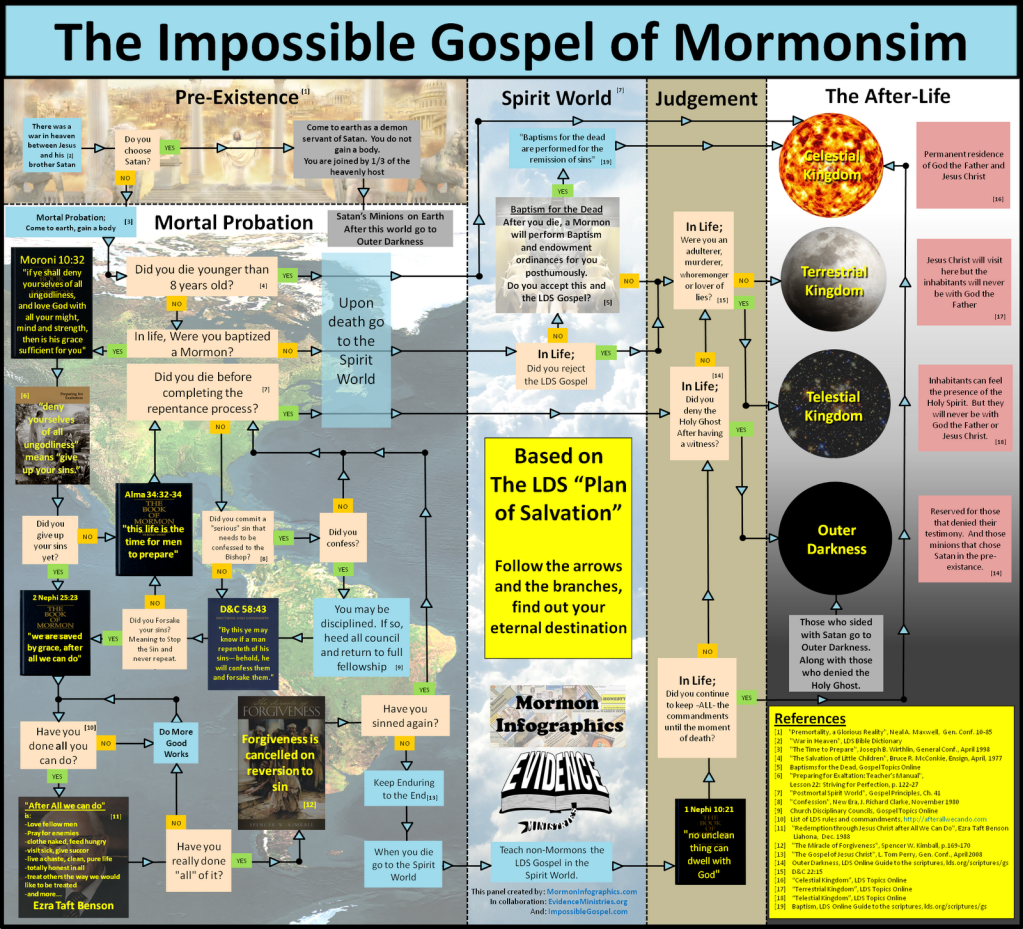
It is important when witnessing to Mormons to know what they believe. Here is a quick summary:
The most effective way to witness to Latter Day Saints (i.e. LDS, Mormons):
Part 1
Part 2
Subscribe to:
Posts (Atom)