Showing posts with label Dawson Bethrick. Show all posts

Sunday, September 15, 2013

Monday, June 17, 2013

Skepticism

I have noticed atheists have now resorted to skepticism as a basis for a counter-argument against presuppositional apologetics.


This video makes a lot of claims that seem to follow the ideas from Michael Martin's article TANG. The latter article has been addressed by both Michael Butler and John Frame so I will not further discuss it here. I wish to only address those points that seem to be a counter-argument. First, then we go to epistemology. The video builds an argument on a false analogy between God and a king. This is obvious when one looks to perfect being theology. By definition God is the greatest conceivable being; He is the most perfect being (hence the name perfect being theology). If this is the case, then there is no substantial parallel between God and the king in the video. However if we grant the false analogy further problems arise. First, the analogy illustrates a misunderstanding of the Presuppositional argument. Since the unbeliever seeks to reverse the the argument back on the believer. As one's modus ponens is another person's modus tollens. Here the problem is made explicit. The believer affirms that God is the necessary starting point to make sense of human experience and thought. Sye Ten Bruggencate argues this affirmation by pressing the unbeliever to admit knowledge is impossible in terms of the non-christian worldview. The alleged counter-argument is that the christian too is left in the same kind of skepticism. Since the believer can not ground his belief that God is not deceiving him. What is the problem of this argument? First, it acknowledges Christianity as the necessary presupposition of thought and human experience in attempt to show it is self-refuting. But it does not demonstrate Christianity is in fact self-refuting. Vincent Cheung explains this problem well:

    
"They suggest that according to my view, I could be deceived in affirming my view. First, this is just outright stupid, since the Bible says that God can send evil spirits to convince people of error. So no matter how it happens, God is the one who decrees that someone would be deceived. Second, they demonstrate that they really have no idea how to perform this fatal maneuver, since it again backfires against them. If I am deceived in the way that the objection suggests (that is, by my own explanation of how one comes to believe falsehood), then it actually proves my position. If I am deceived in the way that I say one is deceived, then I am in fact not deceived. To illustrate, if God sends a demon to "deceive" someone into thinking that God does not send demons to deceive, then God does send demons to deceive. Likewise, if God causes me to believe the "falsehood" that it is God who causes one to believe falsehood, then God does cause one to believe falsehood, and I am in fact not deceived. In other words, my position cannot be demonstrated as self-refuting in the manner attempted by the objection."[1]
Secondly, the counter-argument assumes there is truth. Since one cannot have doubt, deception, or falsehood without a standard of certainty, honesty, and truth. And this standard must be justified by the unbeliever. However, if the unbeliever rightly understood the presuppositional argument, then he would  know even deception is impossible without starting first with the God of Scripture. Moreover, the video asserts starting with God does not justify knowledge, logic, and regularity as simply as naturalism. This assertion is plainly false since the video advocates fideism. This has been dealt with here and hereOne must presuppose the reliability of sensation and justify it by scripture which is circular reasoning (not a problem), but it results in two circles sensation is justified by scripture and scripture is justified by sensation. This demonstrates reason presupposes faith and that human experience and everything that is meaningful--sensation, induction, intuition, logic, free-will (free agency) morals,-- hinges on the truthfulness of the Christian worldview. Furthermore, contemporary religious epistemology is not even consulted for the premises of the unbeliever's arguments which leaves the arguments susceptible to refutation in light of this neglected data.   

The video asserts logic and the regularity of nature operates given the essences of their respective natures. Matter operates consistent with matter and this is how regularity can be justified. The problem with such a view is simply it begs the question. How does one know all matter operates the same? Have you tested every atom? If not, then the unbeliever is assuming without justification that from particulars one can get universals. It gets even more precise, if the unbeliever is an empiricist, then since he cannot observe the empirical connection between causes and effects, he is left in skepticism.    


[1] www.vincentcheung.com/2006/03/01/the-fatal-maneuver/    

Sunday, June 16, 2013

The Burden of Proof

Most atheists will affirm the burden of proof lays on the christian since he or she asserts a positive claim, namely God exists. However, no claims can be made in a vacuum. Both the atheist and christian make truth claims either explicitly or implicitly. For example, the atheist affirms metaphysical naturalism and the christian affirms metaphysical supernaturalism. Therefore, both stand in positions of taking on a burden of proof.  

If the atheist insists the christian provide evidence for his claims, implicitly the atheist presupposes a criterion for claims, which must be justified, since it is a claim. And thus he is left with the burden of proof of justifying the validity of his criterion for truth. Furthermore, if the atheist demands proof from the christian, the christian can legitimately request the atheist to provide an metaphysical foundation for the epistemic obligation he appeals to when the atheist says, "all rational persons ought to have justification for their claims."    

In summary then, there are no neutral positions. The christian and atheist have an epistemic responsibility to justify his/her beliefs. The burden of proof belongs to both the christian and unbeliever.

Tuesday, June 11, 2013

Thoughts on Empiricism

There are only a few positions to take regarding universals. 

Either,


(1) universals reduce to particulars, o(2) universals and particulars are distinct.
If (1) is the case, then some form of nominalism is true. If (2) is true, some form of either realism or conceptualism is true. 

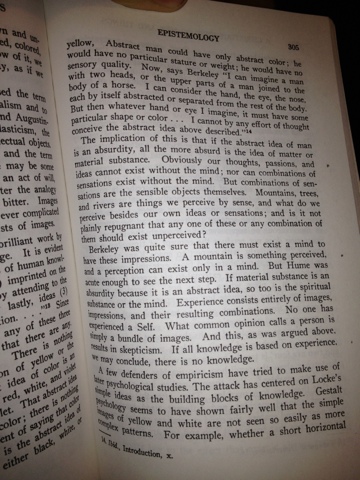
Given (1), abstractionism asserts universals are formed by particulars. An agent encounters a particular via sense perception and then by inference abstracts a universal. For example, Sally sees a particular human, then infers from this general characteristics that form the concept of humanity.  Universal concepts are allegedly open-ended, they point to an indefinite number of things.

Problems
The term abstraction is vague. It does not analytically explain the process in which universals are formed from particulars. Moreover, a logical definition of the term cannot be provided.


Logically how can one abstract concepts, like time, space, and color, from particular sensations?  

To say universal concepts are open ended is to confuse semantics with ontology. The issue is not if words are vague in picking out concretes; rather, the issue is if words in fact pick out universal concepts that exist.

How can one from sensations infer perceptions and abstractions and then determine if the perceptions are in fact true? Kant had a similar problem with his Ding an sich


Abstraction presupposes there are persons with minds, sensations, beliefs, thoughts, and intentionality without setting forth a metaphysical view that can account for such things. But logically prior to giving reasons for abstraction, one must logically justify empiricism.

It is impossible to show logically that universals come from particulars. Since such a demonstration would rely on induction which assumes the very thing one needs to prove, namely that one can get universals from particulars.


Gordon H. Clark's thoughts on the subject from his "A Christian View of Men and Things."