I provided a book review of Dr. Jeffrey D. Johnson’s book related to Classical theism and ongoing debates in theology proper.
Showing posts with label Gordon Clark. Show all posts
Showing posts with label Gordon Clark. Show all posts
Thursday, April 4, 2024

Wednesday, December 28, 2016
Gordon Clark's Philosophy

Clark doesn't explain precisely how knowledge is revealed. Is it by telepathy? Does man create language as it reflects God? If so, does this not entail Adam had an actual private language (at one point in time)? Does not a private language entail self-knowledge? If a private language is denied, then language is a social construct, then how can there be agreement between symbols that matches thoughts without self-knowledge? How precisely does first order knowledge (e.g. I know P) refute Skepticism, if second order knowledge (e.g. I know that I know P) is denied? Moreover, how is skepticism circumvented if there is no standard to confirm language and thoughts match? If Clark appeals to the Divine Logos to prevent skepticism, does not Christian empiricists (e.g. Representational realists) have the same option?
Clark's demand for a definition of sensations is reasonable. Yet it is not necessary to define sensations in order to possess prima facie warrant to believe in sensations. It strikes me as a category mistake to require a definition of sensations in terms of logic and math. (e.g. Rationalism requires empiricism to provide definitions in terms of Rationalism or Empiricism contend Rationalism provide an definition in terms of empiricism).The traditional definition of sensations is a non-propositional experience possessed by an experiencing subject. Further distinctions are made in philosophy of perception (e.g. Seeing, seeing as, and seeing that). Thomas Reid makes a helpful point that sensations cannot be reduced to a mere logical definition. Hence, my charge that Clark seems to make a category mistake (e.g. The smell of logic). I think sensations and/or experiences are irreducible to a mere logical definition but that is not to render them unintelligible. For example, we can make sense of the sensation of pain but pain is not reducible to C-fiber stimulation or a mere logical definition (e.g. A person experiences the sensation of pain iff a person's physical body functions properly to interact with the mind in which the mind is aware " I am in pain."
Clark states God causes us to believe in Christianity. In what sense does God 'cause' us to believe? Obviously Clark excludes any empirical method. It's like saying, "I don't know what a 2017 Honda Civic looks like but it doesn't look like that! Clark does narrow what he considers how God 'causes' us to know. It reminds me of the brain in a vat thought experiment. We are to suppose the possibility of a person existing as a brain in a vat. Next, we are to envision an agent (often a mad scientist or demon--take your pick) is the primary efficient cause of the person's beliefs by electrodes. This thought experiment is often leveled in favor of skepticism. The warrant for beliefs is argued to be underdetermined. Any argument put forward against such skepticism is argued to be based upon beliefs from the agent (presupposing skepticism). I wish to make two points. First, 'cause' deals primarily with metaphysics and ''beliefs' deal with epistemology. If it is granted a causal process produces beliefs then beliefs are not acquired merely for their truth-value but due to the intentionality of an agent. Second, this view seems to commit the genetic fallacy. If one traces the belief to its origin this does not make it true nor false. Furthermore, it commits the naturalistic fallacy. It confuses what 'is' the case (e.g. I believe P) for what 'ought' to be the case (e.g. I ought to believe P). Thomas Reid, the Old Princeton tradition and arguably Plantinga would argue directly a posteriori with properly functioning cognitive faculties. My point is to demand a definition of experiences, e.g. experiencing the color red, such a request seems to confuse categories on the one hand and denies any limit to the extent of how far such a demand can be met.
(1) If Clark's metaphysics is deduced from his epistemology then his epistemology can be understood from his metaphysics.
(2) Clark's metaphysics is deduced from his epistemology
(3) Therefore, Clark's epistemology can be understood from his metaphysics.
In Clark's metaphysics propositions are the object of thought and knowledge not things. The only logically possible world is the actual world. God actualized the actual world comprised of propositions (that can be further reduced to subjects and predicates). All propositions are logically necessary. But some, if not all, propositions are necessarily instantiated (in virtue of necessitarianism). Each proposition is necessarily true.
Each person is (i.e. in the sense of identity) a set of propositions. Any given person is what he/she thinks. I think it can be argued Dr. Clark's system may be properly associated with epistemic foundationalism, accessible internalism, infallibilism, metaphysical realism and a coherentism theory of truth. But in particular on epistemic justification an argument can be formulated in favor of some form of internalism:
(1) If Clark affirmed some form of reliabilism/externalism then a person is warranted/rational to believe X, independent of any accessible reasons.
(1a) If any given belief must be deduced by its axiom to be justified then Clark affirmed any given system of beliefs must be logically deduced from its axiom to be justified.
(1b) Any given belief must be deduced by its axiom to be justified.
(1c) Clark affirmed any given system of beliefs must be logically deduced from its axiom to be justified.
(1d) Logical deduction either requires mental awareness or mental unawareness
(1e) not mental unawareness
(1f) mental awareness
(2) A person is not warranted/rational to believe X, independent of any accessible reasons.
(3) Clark did not affirm some form of reliabilism/externalism.
Premise (2) can be demonstrated by Clark's critical analysis of ideas contrary to his. He didn't simply level objections/defeaters. He demanded reasons from his opponents. Clark argued against any position that allowed for the possibility of skepticism. Reliabilism/externalism argues a belief is warranted without conscious awareness, if and only if any given belief is produced by a reliable belief forming process, in the absence of defeaters. But this does not assail skepticism since a person would need to "know" all his/her beliefs are produced by a reliable belief forming process to avoid skepticism. This will not do for Clark. Also, the doctrine of divine simplicity entails some form of internalism (e.g. epistemic mentalism). God's omniscience flows from His decrees. In other words, divine foreknowledge is grounded in divine foreordaination.
Sunday, July 12, 2015
Sovereignty and Scripturalism
What I've been thinking about lately:
I read a post of an Arminian that argued sovereignty is a contingent attribute of God. I couldn't help but think this in and of itself doesn't go far; one must distinguish between eternal or temporal contingency. Still, this doesn't help the Arminian's case since sovereignty seems to be essentially grounded in all of God's attributes (i.e. authority, knowledge, power, goodness, freedom and control). Perhaps, one could say God is sovereign independent of creation in virtue of God qua God exists in all possible worlds with the power to actualize any possible world He eternally decrees by divine wisdom. In a sense God is sovereign over those things which are possible (things He chooses not to actualize) and those things which are actual (things He has created).
Steve Hays posted a critique of Scripturalism; I've enjoyed his interaction with Ryan a Clarkian in the comments section. Paul Manata made a comment that I think is worth considering. Can epistemic infallablism be shown to be true? If it is possible then must it be actual? Cannot axiom S5 help to demonstrate this? If so, is this wildly counterintuitive?
I read a post of an Arminian that argued sovereignty is a contingent attribute of God. I couldn't help but think this in and of itself doesn't go far; one must distinguish between eternal or temporal contingency. Still, this doesn't help the Arminian's case since sovereignty seems to be essentially grounded in all of God's attributes (i.e. authority, knowledge, power, goodness, freedom and control). Perhaps, one could say God is sovereign independent of creation in virtue of God qua God exists in all possible worlds with the power to actualize any possible world He eternally decrees by divine wisdom. In a sense God is sovereign over those things which are possible (things He chooses not to actualize) and those things which are actual (things He has created).
Steve Hays posted a critique of Scripturalism; I've enjoyed his interaction with Ryan a Clarkian in the comments section. Paul Manata made a comment that I think is worth considering. Can epistemic infallablism be shown to be true? If it is possible then must it be actual? Cannot axiom S5 help to demonstrate this? If so, is this wildly counterintuitive?
Tuesday, June 11, 2013
Thoughts on Empiricism
There are only a few positions to take regarding universals.
Either,
(1) universals reduce to particulars, or (2) universals and particulars are distinct.


Either,
(1) universals reduce to particulars, or (2) universals and particulars are distinct.
If (1) is the case, then some form of nominalism is true. If (2) is true, some form of either realism or conceptualism is true.
Given (1), abstractionism asserts universals are formed by particulars. An agent encounters a particular via sense perception and then by inference abstracts a universal. For example, Sally sees a particular human, then infers from this general characteristics that form the concept of humanity. Universal concepts are allegedly open-ended, they point to an indefinite number of things.
Problems
The term abstraction is vague. It does not analytically explain the process in which universals are formed from particulars. Moreover, a logical definition of the term cannot be provided.
Logically how can one abstract concepts, like time, space, and color, from particular sensations?
To say universal concepts are open ended is to confuse semantics with ontology. The issue is not if words are vague in picking out concretes; rather, the issue is if words in fact pick out universal concepts that exist.
How can one from sensations infer perceptions and abstractions and then determine if the perceptions are in fact true? Kant had a similar problem with his Ding an sich.
Abstraction presupposes there are persons with minds, sensations, beliefs, thoughts, and intentionality without setting forth a metaphysical view that can account for such things. But logically prior to giving reasons for abstraction, one must logically justify empiricism.
Problems
The term abstraction is vague. It does not analytically explain the process in which universals are formed from particulars. Moreover, a logical definition of the term cannot be provided.
Logically how can one abstract concepts, like time, space, and color, from particular sensations?
To say universal concepts are open ended is to confuse semantics with ontology. The issue is not if words are vague in picking out concretes; rather, the issue is if words in fact pick out universal concepts that exist.
How can one from sensations infer perceptions and abstractions and then determine if the perceptions are in fact true? Kant had a similar problem with his Ding an sich.
Abstraction presupposes there are persons with minds, sensations, beliefs, thoughts, and intentionality without setting forth a metaphysical view that can account for such things. But logically prior to giving reasons for abstraction, one must logically justify empiricism.
It is impossible to show logically that universals come from particulars. Since such a demonstration would rely on induction which assumes the very thing one needs to prove, namely that one can get universals from particulars.
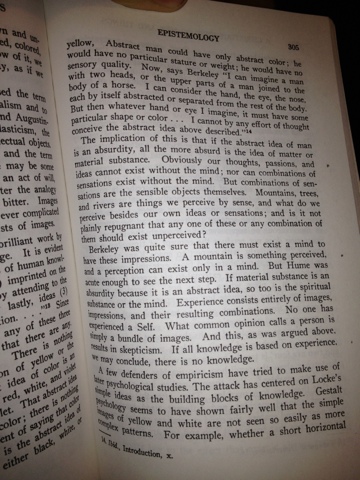
Gordon H. Clark's thoughts on the subject from his "A Christian View of Men and Things."
Gordon H. Clark's thoughts on the subject from his "A Christian View of Men and Things."
Tuesday, May 21, 2013
God, why is there evil?
Many Christians and non-Christians alike are troubled by evil in the world. For the former it is a testimony of God's mercy and sovereignty. But for the latter it is viewed as supposedly a disproof of God's existence.
JP Moreland Q&A
Timothy Keller
Alvin Plantinga
Greg Koukl
William Downing. The Problem of Evil. HERE
John Byl. God, Chance and Evil. HERE
Greg Bahnsen. The Problem of Evil. Covenant Media Foundation. HERE
The problem can be stated in different ways but in the end it reduces to questioning God's reasons for providentially planning and sustaining the existence of evil. The question why does God allow evil and suffering in the world, I think is a difficult question. Here are some plausible answers:
Miscellaneous Videos Dealing with Evil from various Theological Traditions:
1. God has a morally sufficient reason for why he allows evil to exist. To argue he doesn't cannot be shown by limited human knowledge.
2. It is for a greater good. We do not see the big picture of all the events that occur but God is orchestrating them for ultimate good. For example, Jesus died by the hands of wicked men so those that repent and trust in Him may have everlasting life.
3. God created laws of nature. If God intervened every time evil or suffering occurred what would stop people from demanding God to intervene for everything at every time? It doesn't sound like atheists want evil and suffering to stop, it sounds like they want heaven on earth.
4. God uses evil and suffering to build our character.
5. God gave humans originally the freedom of choice. God did not force Adam and Eve to love and obey him. He gave them the ability to choose good or evil.
6. If God removed evil from the world, like rape, God to be fair would be obligated to punish not just some but all evil and suffering. Everyone would cease to exist because all evil and suffering is the results of sin. Everyone is guilty not innocent so all would cease to exist if God chose to destroy evil now instead of deal with it through the cross of Christ.
7. God created all things, rules all things, controls all things, and owns all things. This means God has the right to do whatever he wants with his property (i.e. creation). Or as Romans 9 puts it, the potter has power over the clay to do whatever he wills with it.
Ultimately I think it all comes down to what we put our trust in. Are we going to trust God’s infinite knowledge and wisdom or man’s limited knowledge?
Gregory E. Ganssle
Voddie Baucham
Tim Keller
The Free will Defense
What is Evil?
\
The Problem of Suffering and Evil. William Lane Craig (Part 1, 2 and 3)
JP Moreland Q&A
Timothy Keller
Alvin Plantinga
Greg Koukl
Richard Swinburne
Ravi Zacharias
Bruce Little
Resources
William Downing. The Problem of Evil. HERE
John Byl. God, Chance and Evil. HERE
Greg Bahnsen. The Problem of Evil. Covenant Media Foundation. HERE
Scott K. Oliphint. HERE
E. Calvin Beisner. The
Potter’s Freedom. HERE
John Frame HERE
Greg Welty HERE
Cornelius Van Til HERE
Vincent Cheung HERE
Bruce Little. Evil and
The God Who Knows HERE
William M. Schweitzer, Rethinking the 'Problem of Evil' in The Banner Of Truth Magazine, May 2013, Issue 596 (Banner Trust: Edinburgh, 2013)p.25.
Czapkay Suddeth, Michael. Absolute Predestination and Divine Permission.1989. p.p.66-75.
Paul Copan. "If God's Creation Was 'Very Good', How Could Evil Arise?"
http://enrichmentjournal.ag.org/201301/201301_024_good_creation.cfm
http://enrichmentjournal.ag.org/201301/201301_024_good_creation.cfm
Subscribe to:
Posts (Atom)