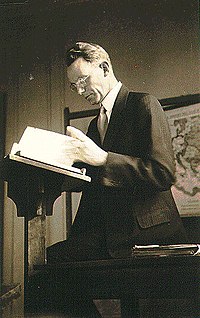
Showing posts with label Gordon H. Clark. Show all posts

Sunday, January 26, 2014

Clark's Thought

After some criticism from a friend, on my previous post of Clark and Van Til, I repost this article on Dr. Gordon Clark to be more balanced (i.e. less VanTillian). This is a repost from my Clark blog (here).


I would like to just highlight a few of the important features of Dr. Gordon Haddon Clark's system of thought. For a more complete introduction to Dr. Clark's thought see Gary W. Crampton's, Trinity Review, entitled, Scripturalism: A Christian Worldview (here)

Epistemology

Dr. Gordon Clark first would start with epistemology. Since before there can be talk of objects there must be established a system that can bring together subjects and objects. There must be an epistemic axiom, a starting point, that makes knowledge possible. Dr. Clark would argue that knowledge is possible, not by sensation or reason but, by divine propositional revelation. 

 Significantly, contrary to what Empiricism maintains, sensations can never convey or organize information that has truth-value. Nor can knowledge come from the senses in virtue of the ontology, ambiguity, unreliability, and relativity of sensations. Yet God created all mankind with innate propositional knowledge. However, this knowledge can only come to man's mind by Jesus Christ, the Divine Logos, revealing the propositional Word of God. 

As the Lord Jesus Christ, the Divine Logos, reveals the propositional Word of God to our minds we come to know the only axiom that can furnish us knowledge is the Bible alone, God's very thoughts and words for man. By the same token, we know the biblical axiom's deduced propositions entail consistency, coherence and richness to provide a system of thought that can account for Religion, Knowledge, Science, History, Politics, and Ethics.     

Metaphysics

It is disputed among Clarkian scholars if Clark was an Absolute Idealist. Dr. Robert Reymond and Dr. Ronald Nash both thought this. Dr. Reymond writes,

"Quoting Acts 17:28, “In him we live, and move, and have our being,” Clark affirms that “the New Testament is clear: we live and move and have our being in God’s mind,” and he then draws the conclusion that “our existence in the mind of God puts us in contact with the ideas in the mind of God.” Quoting 1 Corinthians 2:16 and Philippians 2:5, Clark asserts that these verses mean that “our mind and Christ’s mind overlap or have a common area or coincide in certain propositions” (ibid., p. 406–407). This obviously means for Clark that our thoughts, indeed, our very existence, are real only in the sense that God is thinking us and our thoughts. But this is a form of absolute idealism."(1)
I tend to be more charitable of Clark and view his thought in the tradition of St. Augustine who gleaned from the insights of Plato. So in my interpretation of Clark's metaphysics he is a realist.  There is an objective world independent of human minds. However, God is the creator, sustainer, and goal of all things. And thus God's mind is the standard and power that sustains and relates human minds and the world together. Therefore, there is a distinction between the Creator and creation. 

In Clark's view, God determines all things. By God's decree man was created in the very image of God. Whereby God communicated to man the same quality of rationality. Such that God and man think the same thoughts. Moreover, God's knowledge is exhaustive while man's knowledge is limited and dependent upon divine revelation. 

Some have suggested Clark brings God down to man's level since there is no significant creator/creature distinction. But quite the opposite, the distinction between the Creator and creature lies in the very designation of the 'Creator' and 'creature.' The former is the originator, the latter is not. More can be cited but I find it unnecessary here.  

Ethics

Dr. Clark held to a divine command theory of ethics. So he emphasized God's sovereignty over any moral intuitions man may have; and he grounded objective moral values in God's will and decree. Since divine simplicity tells us that God wills His own existence, and character. We conclude then, God also wills what commandments man ought to obey. But not being himself bound by the commandments He establishes for man. 

For Dr. Clark there is no such thing as free-will, man is accountable simply by the fact that God is the highest authority, who has established obligations to man, that will hold man responsible for disobedience. As Dr. Clark writes 

“God is neither responsible nor sinful, even though He is the only ultimate cause of everything. He is not sinful because in the first place whatever God does is just and right. It is just and right simply in virtue of the fact that He does it. Justice or righteousness is not a standard external to God to which God is obligated to submit. Righteousness is what God does…God’s causing a man to sin is not sin. There is no law, superior to God, which forbids Him to decree sinful acts. Sin presupposes a law, for sin is lawlessness. Sin is any want of conformity unto or transgression of the law of God. But God is “Ex-lex.” (2)


---------------------
(1) Robert Reymond. The Justification of Knowledge. p.72.
(2) Gordon H. Clark. Christian Philosophy, vol 4. Unicoi: Trinity Foundation, 2004. p. 269.
See also Sean Gerety's recent post, God is Not Responsible For Sin. 

Friday, January 10, 2014

Clark and Van Til


There are two very different traditions of presuppositionalism. The first comes from Dr. Gordon H. Clark. Dr. Clark understood Christianity as a system of thought. He treated it much like Euclidian Geometry. The Christian system is comprised of propositions (or theorems) that are deduced from the axiom of scripture. The axiom (first principle, or presupposition) for the Christian is the Bible alone is the Word of God. This axiom is selected among other possible axioms because of God’s illumination (by Christ and the Holy Spirit) and the axiom’s consistency and richness, i.e. its ability to provide knowledge. In other words, unlike other possible axioms, God reveals the Christian axiom to be true and it can solve problems in Epistemology, Metaphysics and Ethics. 

Dr. Clark’s presuppositionalism follows the tradition of Augustine's rationalism with its denial of sense perception. But contra traditional Rationalism of Descartes, Spinoza, and Leibniz, Dr. Clark argued the laws of logic (i.e. the laws: of identity, excluded middle, non-contradiction, rational inference) have no content to them; hence, the laws as our sole axiom furnish us with very few theorems, if any.  Thus the laws of logic alone are not broad enough as an axiom. We must start from the sure foundation of Scripture. As the Holy Spirit has revealed it's truth to our minds. By this standard Dr. Clark repudiates all forms of Empiricism and uses this as an advantage in apologetics. This approach can be properly distinguished from traditional Rationalism as Dogmatism or Scripturalism. As Dr. Clark argued forcefully that knowledge is exclusively what is deduced explicitly or implicitly by the axiom of Scripture. This axiom, as a presupposition, is shown to be true by the Holy Spirit; and by the axiom's ability to solve simple and complex problems in thought. 

Dr. Clark was a Philosopher par excellence. So Clark’s main arsenal in apologetics is logical analysis of worldviews. He quite often, and brilliantly if I might add, uses reductio ad absurdum type arguments in refuting detractors.


The second tradition in the presuppositional school comes from Dr. Cornelius Van Til. Dr. Van Til thought of everything in terms of worldviews with presuppositions (e.g. Kuyper). But also acknowledged, as the Old Princeton School per Thomas Reid, all men as image bearers of God know Him innately, but they suppress the truth in unrighteousness. The noetic effects of sin preclude man from coming to a saving knowledge of God. Moreover, man as a rebel against God views himself as autonomous (i.e. the final standard for meaning and truth). However, the noetic effects of sin does not render apologetics useless. Van Til, unlike Abraham Kuyper, believed Christians have an ultimate proof of Christianity at its disposal—the transcendental argument for God’s existence. The first step to this approach is to deny religious neutrality and human autonomy. There is no middle ground between worldviews. A person is either committed to Christ or Satan. One either affirms Christianity or a token of the Non-Christian type. Furthermore only God, as described in Scripture, is the ultimate standard of meaning and truth. Here is where Dr. Van Till’s brilliance shined. Dr. Van Til argued that if the non-Christian is epistemically self-conscious (of his spurious human autonomy), he would be confronted with the necessity of the Christian presupposition, namely, only God, as described in Scripture, is the ultimate authority and source of meaning and truth.

The Christian should not argue for Christianity merely by empiricism, rationalism or existentialism; rather the Christian argues for the truth of Christianity transcendentally. He argues that the Christian worldview is the transcendental precondition for human thought and experience. Thus the Christian worldview is necessary to bring unity and completeness to the divided perspectives of empiricism (situational), rationalism (normative) or existentialism (subjective). 

In modern vernacular, unless the Christian worldview is true one cannot prove anything. The argument is formulated loosely by confronting non-Christians to make sense of knowledge, rationality, induction, freedom and morals all the while assuming human autonomy. Dr. Van Til called this arguing from the impossibility of the contrary (much like in Geometry the argument from contradiction). Once the presupposition of human autonomy is logically demonstrated as impossible then the Christian presupposition is offered as the only alternative to make sense of knowledge, rationality, induction, freedom and morals.

Dr. Van Til emphasized that all men have presuppositions (i.e. beliefs used to interpret evidence). Thus no one is religiously neutral to be able to follow the evidence whereever it leads. A person is either committed to Christ or Satan. In the context of truth and meaning, one is either committed to autonomy (self-law) or theonomy (God’s-law). The Christian proves his presupposition transcendentally.   He argues from the impossibility of the contrary (i.e. unless the Christian worldview is true one cannot prove anything).

Van Til was not opposed to reason. He viewed reason as a tool of God. Van Till understood reason as derivative from God. God, who is essentially and originally rational, created man rational after His image. God gave truth and meaning to the actual world. He was the ultimate standard for meaning and truth, which included proper interpretation of the actual state of affairs. However, after the fall, man exchanged the creator for the creature and became vain in his reasoning. Man placed himself on the throne of God; he claimed the right to be essentially and originally rational.  Man asserted his reasoning as the measure/judge of all things (including God and the Bible). In effect, fallen man asserted his reasoning alone was the ontic and epistemic foundation for knowledge, rationality, induction, freedom and morals. Fallen man sees these things as human constructs with man at its source. Van Til turned this kind of reasoning on its head by arguing for a Copernican revolution in apologetics we now call covenantal or presuppositional apologetics.   

Van Til was concerned to rightly put human reason in its proper place under God’s rationality, authority, control, presence and power. Such a task is accomplished when we argue transcendentally.

Dr. John Frame rightly shatters the criticism that presuppositionalism merely argues in a circle. First, Frame points out the logical order of a Biblical epistemology can be conceived as linear (e.g. God’s rationality ->; human faith -->; human reasoning). In God’s rational providence, He produces human faith that governs human reasoning. All three of these components are inseparable. One cannot reason without faith (in reason); and one cannot justify either faith or reason without God.

Synthesis

Scholars (e.g. Carnell, Reymond, Nash, Frame) have examined their apologetical contributions and  identify weaknesses and strengths to provide a synthesis of the best their systems offered.  


Tuesday, February 26, 2013

Why Didn't God Create the World Differently?

Does God's nature, specifically omnisapience, entail there is only one possible world He would have created and this is the best of all possible worlds? Some of Paul Helm's thoughts [1] that indirectly touches on the question would help here; and then I will make a few comments.

  Helm makes it clear God chooses to create the world consistently with His nature and plan.

Helm states the world is contingent. God could have eternally chose not to create. But, God, given His nature and plans, chose freely to create the world.
   Helm is direct in saying this is the only possible world God would create given His nature and plans. But if the question is "could God have created the world differently?" the answer is yes he had the power to do so, but it did not please Him to do so given His nature and plans. Hence God would not create the world differently than He did since it is according to His nature and plan. But the question arises following Leibniz, "Is the actual world the best of all possible worlds God could have created?"
The answer seems to be yes and no! Yes it is the best according to God's nature and plan. No because value and worth comes from God. Something can only rightly be called the best ( e.g. any given possible world) because God makes it the best. There is no "best making properties" in possible worlds in which God chooses the one that has the most of such properties. Rather, God creates the world by His nature and plan. We must keep in mind, it is He who states if something is the best (if it exemplifies His nature and what He thinks is best). God has not revealed the actual world is the best. Therefore, we must not conclude it is or is not. However, we do know God is not obligated to always and only create the best. In fact, it is quite possible He may create something that is not the best (a world with deficiencies) to all the more demonstrate Himself as the best.  John Frame commenting on evil says,

"People sometimes say that God must make the best possible world because he himself is perfect. So they think that although evil exists now, this is nevertheless the best world God could have made. That is one traditional attempt to solve the problem of evil.
I disagree, however. Genesis 1:31 says that God made everything good, but not perfect. “Perfect” would mean not only good, but also incapable of becoming evil. Clearly God did not choose to make that kind of world. In that sense, the new Heavens and the new Earth (Rev. 21:1) will be a better world than this one, for that world will be confirmed in goodness, incapable of becoming evil. So the world in which we presently live is not the best possible world. God is free to make a world that is imperfect in some respects.
 Could God have made a better world than this one? Certainly. He could have made what we call the “new Heavens and new Earth” right back at the beginning. Why, then, did he choose not to do so? I don’t know. That is essentially the problem of evil. I think there are some biblical ways of addressing the problem, but I don’t think we will have a completely satisfying resolution of the problem during our present life."[2]   
William Lane Craig discussing the Ontological argument writes,

"Now concerning your theological misgiving: I don’t see that this has anything to do with God’s being metaphysically necessary. Even if God exists contingently, so long as He is essentially morally perfect you can run your argument that He is morally obligated to do the best and therefore must create the best possible world. So this is a problem that faces any theist who thinks that God is morally perfect.
The misgiving is to be met, I think, by questioning the assumption that there is a best of all possible worlds. Worlds may just get better and better without limit. For any world God chooses to create there will always be a better one that He could have created. God must at most create a good world, not the best world (since there is no such thing). Moreover, there’s no reason to think that God must create anything at all. In a possible world in which God creates nothing, there is only He Himself, the paradigm and locus of goodness—the summum bonum. That’s a pretty good world, to say the least!"[3]


[1] Helm, Paul. The Eternal God: A Study of God Without Time. 2nd ed. (Oxford: Oxford P, 2010) p.p.186-188.
[2] John Frame Interview on the Problem of Evil Here
[3] William Lane Craig. Question 51. Here
           

Tuesday, February 5, 2013

Mulvihill's Lecture on TAG

Joe Mulvihill gave a lecture on the Transcendental Argument for God's existence Here.


I wish to comment on Mulvihill’s lecture. First, Mulvihill, by his articulation of the Transcendental Argument for God’s existence (TAG), seems to mistake Cornelius Van Til for Gordan Clark and/or Edward John Carnell. Since he wrongly claims TAG is properly understood as a reductio or abductive argument. Despite what Mulvihill may think, Van Til in fact taught that TAG is an argument for the impossible of the contrary. It is an indirect argument that demonstrates Christianity is true by presupposing its contradiction, (tokens of the same type) Non-Christianity. Non-Christianity is shown to be impossible, and therefore, it proves the contrary, namely, Christianity is true. “In other words, the structure of the argument is a disjunctive syllogism. Either A or ~A,~~A, therefore, A.”[1]


Mulvihill as a side comment says Van Til might not even be rightly considered a philosopher. Mulvihill seems to follow the footsteps of his colleague William Lane Craig to take such a stance about Van Til. The trouble is both man show their ignorance of Van til; if only they would have bothered to look at Van Til’s dissertation on Hegel’s Absolute, they would not make such inaccurate claims.


Mulvihill’s criticisms of TAG can be summarized as follows:
  1. It is an indirect argument.
  2. It is complex.
  3. It is not unique.

Certainly TAG is indirect but it does not exclude giving positive answers directly. The main concern with TAG is to uphold biblical authority. Man cannot have a positive argument if man thinks it gives him the right to judge God.

TAG can be formulated in different ways both for the academic and student. So it can be simple or complex. To illustrate watch this simple use of TAG by Sye Ten Bruggencate.


TAG is unique; the problem lies with a misunderstanding of the structure of TAG. Michael Butler's comments would be helpful here. Butler explains,  

"But Bahnsen makes the further point is that this criticism misses the thrust of TAG altogether.  TAG argues for the impossibility of the contrary (the non-Christian worldview) and not the impossibility of an infinite number of possible worldviews.  TAG does not establish the necessity of Christianity by inductively refuting each and every possible non-Christian worldview (as finite proponents of TAG, this is an impossible task), but rather contends that the contrary of Christianity (any view that denies the Christian view of God) is shown to be impossible.  And if the negation of Christianity is false, Christianity is proved true.  In other words, the structure of the argument is a disjunctive syllogism.  Either A or -A, -- A, therefore, A.
At this point the clever opponent will simply deny the first premise.  He will contend that it should not be construed as a disjunction of a contradiction, but a simple disjunction.  The argument should thus be restated along the following lines: A or B, -B, therefore, A.  And once this move is made he will then contend that while the argument is valid, the first premise involves a false dilemma.  That is, he will grant that given A or B and the negation of B, A does indeed follow, but nevertheless maintain that the argument is unsound because the first premise (A or B) is not true.  The reason being that there are more possibilities than just A and B.  Given a true first premise, A or B or C or D ... n, the negation of B merely entails that A along with the disjunction of other propositions besides B (C, D,...n) follows.
In order for this to be successful, it is incumbent upon the opponent of TAG to defend two claims.  First, he must defend the contention that the original first premise is not the disjunction of a contradiction and, second, he must show that there are other possible disjuncts besides B (what we can call the view that is opposed to the Christian worldview)."[3]

I strongly suggest Mulvihill and anyone interested in learning a correct presentation of the Transcendental Argument for God's Existence (TAG) to listen to Dr. Greg Bahnsen's lectures Here and Michael Butler (Bahnsen's former student) Here 


[1] Butler, Michael. The Standard Bearer: A Festschrift for Greg L. Bahnsen (Covenant Media Press: Nacogdoches, 2002) p.85. www.butler-harris.org/tag/

[2] Butler, Michael. ;www.butler-harris.org/tag/;